Flying Scotsman
1923 · LNER Class A3 · Work 1 of 1,871
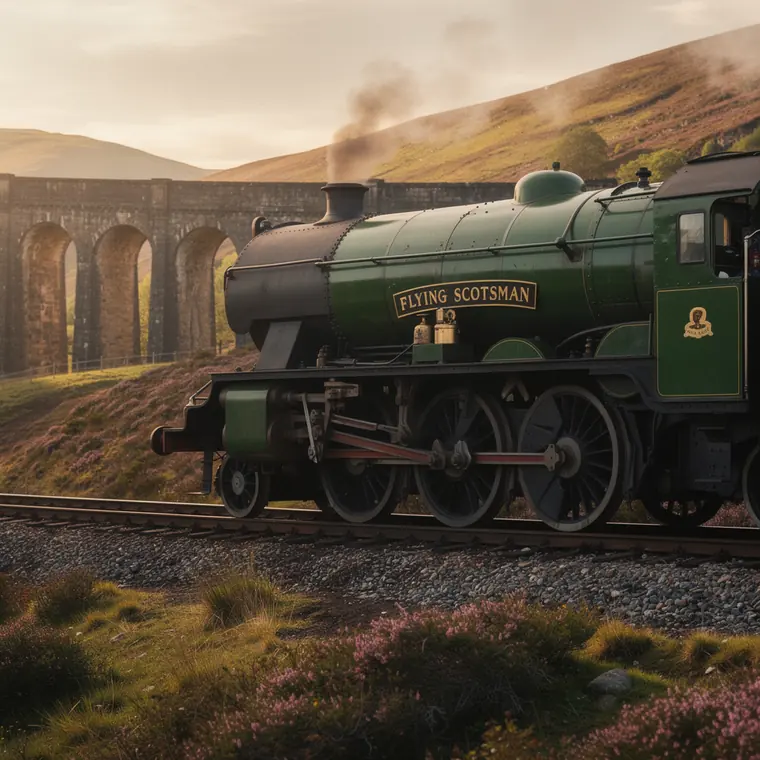
A green express locomotive carrying a curved brass nameplate reading "Flying Scotsman" on its side, crossing a stone viaduct in the Scottish Highlands, heather slopes falling away on both sides, exhaust column standing straight in still air.
- What it was used for
- The London–Edinburgh night service, 632 kilometres non-stop from 1928 — with a corridor through the tender so the crew could change en route. She later became the most expensive monument in British railway history: Alan Pegler bought her privately in 1963, sent her on a promotional tour of some 15,400 miles across the United States and Canada from 1969 to 1971, and was bankrupted by it in 1972 with debts of £132,000. The locomotive then stood in an army depot in California, out of reach of the creditors, until William McAlpine bought her back and brought her home in 1973.
- What was new
- The locomotive was not new; the corridor tender was. It made workable a run longer than a single crew's shift.
Connections
Every connection names its kind. “Forerunner” on its own would be a claim.
- Follows fromPacific Chapelon1940In 1959 Flying Scotsman herself received the double Kylchap chimney (National Railway Museum) – the exhaust André Chapelon had developed in 1926. Gresley had tried it on an A3 in 1937 on Chapelon's advice and adopted it for the A4s; from 1956 Peter Townend at King's Cross pressed for all A3s to get it. The date of work 23 is that of the rebuild, not of the exhaust.Source: National Railway Museum blog: The many guises of Flying Scotsman · Heritage Railway Magazine: Flying Scotsman – More regenerations than Dr Who! (Gresley, Chapelon, 1937) · The Gresley Society Trust: Class A1/A3 (Townend ab 1956, Humorist 1937) · Advanced Steam Traction (AST Group): Kylchap, Kylpor and Lempor Exhausts