Gauss Weber Telegraph
1833 · Galvanometer Telegraph · Work 125 of 1,871
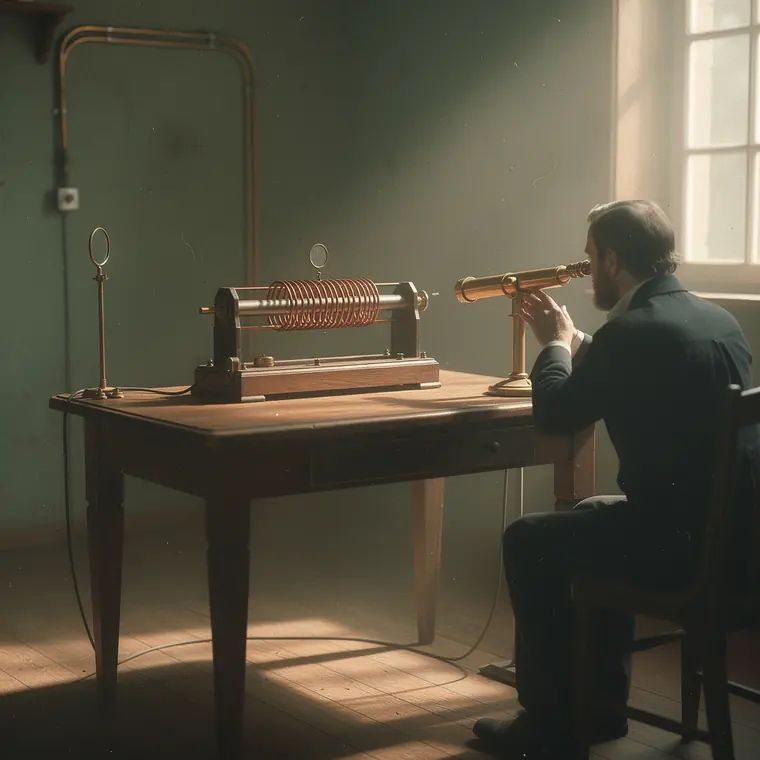
The Gauss and Weber telegraph in the Goettingen magnetic observatory: a heavy straight magnet bar suspended horizontally so that it can swing, a coil of many turns of insulated wire wound around it, a small mirror fixed to the magnet and turning with it, a reading telescope with a scale set some distance away on its own stand and aimed at the mirror, the double wire leaving through the wall, the whole instrument small and still on a table, the observer seated at the telescope.
- What it was used for
- A by-product of the geomagnetic measurements. Because readings were wanted simultaneously in the physics cabinet and at the observatory, Wilhelm Weber in 1833 strung a double wire over the Johannisturm and the Accouchierhaus to Gauss's observatory; Gauss gave the total wire length to Humboldt as about 5,000 feet, while museum figures give a route of some 1.1 to 1.2 km. The line was used by the two men themselves: on 20 November 1833 Gauss wrote to Olbers that the experiments had succeeded very well with whole words and short phrases. It never became a service; that it regularly carried time signals or the term-day observations of the Magnetic Union is not documented in the sources consulted. Weber was removed from his chair in 1837 as one of the Goettingen Seven. On 16 December 1845 lightning destroyed the wires, and Gauss did not have them restored.
- What was new
- It was not the first electric telegraph - Soemmerring in 1809 and Ronalds in 1816 precede it, and Schilling showed his needle apparatus in St Petersburg in October 1832, half a year earlier. What was new was what optical telegraphy could not do at all: Gauss noted that this way of telegraphing was wholly independent of weather and time of day, both parties staying in their rooms, behind closed shutters if they wished. In its mature form the sender was an induction coil on a bar magnet with a reversing switch and needed no battery, the first trials in 1833 still ran on a galvanic cell; the receiver was the magnetometer, read through a telescope. At first, five deflections right or left gave 32 characters - a binary code on one channel, where the needle telegraphs bought legibility with parallel wires.
Connections
Every connection names its kind. “Forerunner” on its own would be a claim.
- Made possibleBaudot Multiplex1874Baudot's 1874 multiplex runs on the five-unit code that Gauss and Weber devised for their Göttingen wire in 1833: five current steps per character, 32 combinations. Vanden Berghen names it explicitly as one of the three building blocks of the system.Source: Fons Vanden Berghen, Émile Baudot (1845-1903), his life and his telegraph, Part 1 (PDF)
Further reading
- Gauss zur Telegraphie (Gauss-CD, Staats- und Universitätsbibliothek Göttingen, 2005)
- Göttinger Messtechnikmeile, Station 1 (Measurement Valley e.V., mit Gauss' Brief an Humboldt vom 13. Juni 1833)
- M. Kersting, Der Gauss-Weber-Telegraf (Physikalisches Museum, Universität Göttingen, PDF)
- Das Gausssche Telegraphenalphabet (Forum Wissen, Universität Göttingen)