Five Needle Telegraph
1837 · Needle Telegraph · Work 127 of 1,871
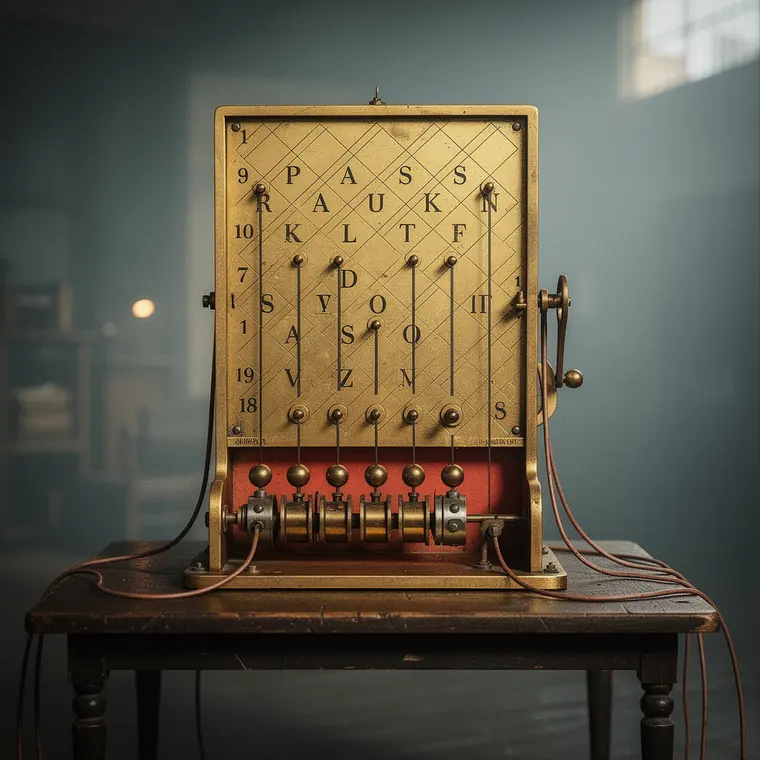
A Cooke and Wheatstone five needle telegraph in the Euston railway station office, five vertical needles deflecting across a diamond lattice dial lettered with twenty letters, paired keys beneath and line wires entering.
- What it was used for
- Cooke and Wheatstone built the apparatus for a prosaic task: the London and Birmingham Railway needed communication between Euston Square and Camden Town to control the stationary steam engines whose ropes hauled trains up an incline. It was demonstrated there in July 1837 and in regular use from September. The first permanent line followed on the Great Western Railway from Paddington to West Drayton, thirteen miles. Which instrument actually worked that line is disputed: the Science Museum's collection entry credits the five-needle set, its own curator John Liffen's research the four-needle one. Of the smaller of the museum's two five-needle instruments, the curator concluded it was probably a working model for a High Court hearing in 1850 at which a rival company disputed priority - the exhibit of the invention is a piece of evidence.
- What was new
- Five needles pointed at twenty letters on a diamond dial, so a message could be read off directly, with no code in the operator's head. That was paid for in letters and in copper: C, J, Q, U, X and Z were dropped to save one needle and its wire, and even so the apparatus needed five lines. The needle principle was not invented here - Schilling showed it in 1832, and the IEEE considers Cooke and Wheatstone's design close to Schilling's solution. Its own advantage was given up quickly: the successor two-needle apparatus worked with coded sequences of deflections and had to be operated by trained staff. Copper cost more than training.
Connections
Every connection names its kind. “Forerunner” on its own would be a claim.
- Follows fromSchilling Needle Telegraph1832After Schilling's demonstration at Bonn in 1835, Professor Muncke had a copy built for his Heidelberg lectures. Cooke saw it there on 6 March 1836 and went back to England to make the thing practical; the needle telegraph of 1837 is the result.Source: William Fothergill Cooke (Engineering and Technology History Wiki, IEEE) · J. Hamel, Historical Account of the Introduction of the Galvanic and Electro-Magnetic Telegraph into England, 1859
- Made possibleThe Signal Box1890In 1842 Cooke's pamphlet "Telegraphic Railways" proposed dividing the line into blocks and reporting each train electrically. Clark's block instrument of 1854 came from an engineer of the Electric Telegraph Company, formed to exploit Cooke and Wheatstone's patents; from 1855 one stood every two and a half miles.Source: Clark's block signalling telegraph instrument, 1854 (Science Museum Group Collection, co27011) · Railway 200: Signalling (Rail Engineer, 2025)
Further reading
- A Tale of Two Telegraphs: Cooke and Wheatstone's (Science Museum Group Journal, Ausgabe 08)
- Revealing the real Cooke and Wheatstone telegraph dial (Science Museum Blog)
- Cooke and Wheatstone five-needle telegraph (Science Museum Group Collection, co32899)
- Cooke and Wheatstone (Distant Writing, Steven Roberts)
- Shilling's Pioneering Contribution to Practical Telegraphy, 1828-1837 (IEEE Milestone, ETHW)