Hughes Type Printer
1855 · Printing Telegraph · Work 130 of 1,871
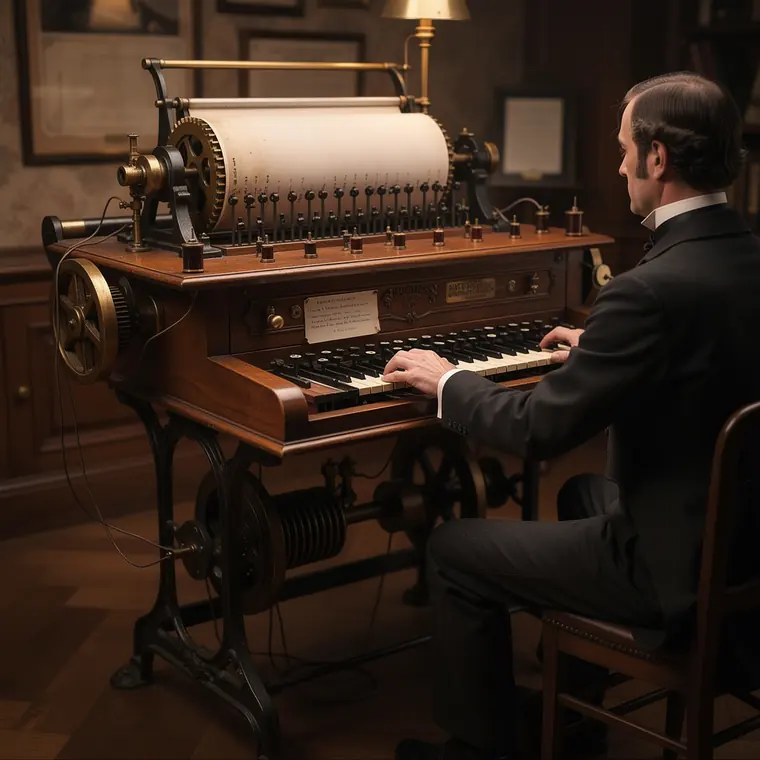
A Hughes printing telegraph on its cast iron frame in a Paris telegraph office: a row of twenty eight piano style keys, black and white like a small piano keyboard, set along the front of the mahogany-topped instrument, behind them a spinning brass type wheel with the letters around its rim printing onto a narrow strip of paper tape, an inked ribbon, the falling weight motor hanging beneath the table on its cord and the vibrating spring governor beside the wheel, the operator seated pressing one key at a time.
- What it was used for
- A type printer that put the message on a strip in ordinary print at the far end. In the United States the apparatus was adopted but very little used; Hughes went to England in 1857, in 1863 the United Kingdom Telegraph Company took it up, with nationalisation in 1870 it passed to the Post Office, and the Submarine Telegraph Company worked it on the continental routes. The Science Museum records that the instruments ran mostly on submarine cables to Europe and that first-class operators could work thirty words a minute. More than 2,300 sets were in service in Europe up to 1930; the keyboard had 28 keys, fourteen black and fourteen white. The American whose machine was left lying at home thereby supplied Europe's trunk instrument for some seventy years, from the 1860s to 1930.
- What was new
- A single, always identical current pulse per character, whose meaning lay in its time interval from the last: the type wheel ran continuously and the strike hit whichever letter it had reached. This removed the transcription into plain text at the receiving end. There is no priority to be had here - attempts at type printing go back into the 1830s, and Geistbeck credits the first type-printing telegraphs to Alfred Vail in 1837. On speed the sources disagree: Geistbeck in 1887 gives 150 letters or 25 words a minute reliably, the Science Museum 30 words, the RWTH collection 3 to 4 characters a second. The advantage that anyone could read the tape without a code was dearly paid for: training an operator took six to nine months, and Geistbeck noted in 1887 that the apparatus required months of preliminary practice and frequent repairs and was usable only at large stations.
Connections
Every connection names its kind. “Forerunner” on its own would be a claim.
- Made possibleBaudot Multiplex1874The French telegraph service sent Baudot on a four-month course of instruction on the Hughes apparatus. His printing telegraph of 1874 takes over its printing mechanism, together with Meyer's distributor of 1871 and the five-unit code.Source: Fons Vanden Berghen, Émile Baudot (1845-1903), his life and his telegraph, Part 1 (PDF)