Wheatstone Automatic
1858 · Punched Tape Telegraph · Work 131 of 1,871
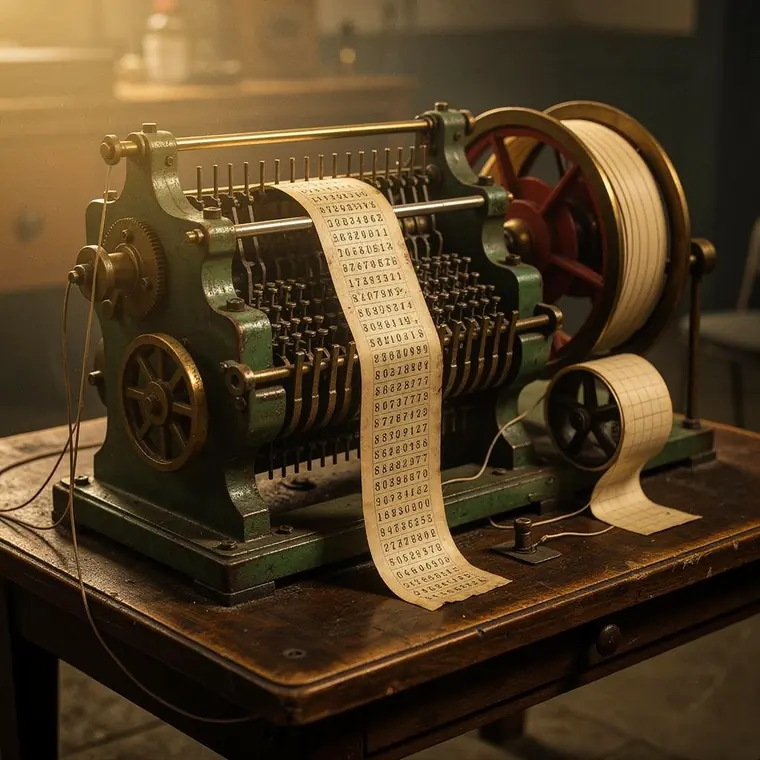
A Wheatstone automatic transmitter in a London telegraph gallery, punched paper tape running between its pecker pins while the three key perforator beside it punches rows of holes into a fresh reel.
- What it was used for
- Punched-tape telegraphy on Britain's long circuits. The Electric Telegraph Company introduced it on the London-Newcastle line in July 1867; later the Post Office ran it. A tape was punched by hand, a transmitter drew it over the line, and a receiver at the far end inked Morse on a slip that telegraphists copied out. The official Post Office pamphlet B.3 of the Engineer-in-Chief's Office names the distribution of press telegrams across the country as its chief use. Staff were still needed: the same pamphlet reckons six operators for a simplex circuit worked at 100 words a minute and eleven under duplex conditions, with a Creed printer bringing the eleven down only to nine.
- What was new
- The line was freed from the hand's rhythm. Text could be punched in advance and then run off faster than a key could give it: about 70 words a minute when it entered service in 1867, according to the Post Office Electrical Engineers' Journal, against roughly 25 by hand Morse. Wheatstone was not first. Alexander Bain had built punched-tape telegraphy years earlier; sources date Bain's forerunner variously to 1843, 1846 or 1850, and some are describing different machines. Nine years separate the patent (1858) from service (1867); the POEEJ of 1956 records both dates side by side. The number of the 1858 British patent could not be found in any source checked.
Connections
Every connection names its kind. “Forerunner” on its own would be a claim.
- Follows fromMorse Register1844The punched slip carries Morse: the Science Museum describes the hand perforator as the device with which operators punched Morse code into the tape, three buttons for dot, space and dash. At the far end an automatic receiver inked the same code onto paper tape. What was new was the pace, not the writing; the characters and the tape record are Morse's.Source: Science Museum Group Collection: Hand perforator for Wheatstone automatic telegraph system (Objekt co8054874) · Distant Writing: Technical Detail (Wheatstone automatic: Perforator, Sender, Empfänger, der den Code auf Papierstreifen schreibt; London-Newcastle Juli 1867)
Further reading
- Post Office Electrical Engineers' Journal, Vol. 49, Oct 1956: Telegraphy
- Post Office Engineering Department, Technical Pamphlet B.3: Wheatstone System. Morse Keyboard Perforators
- Distant Writing: Technical Detail (Wheatstone automatic, London-Newcastle Juli 1867)
- Science Museum Group Collection: Hand perforator for Wheatstone automatic telegraph system
- Distant Writing: Alexander Bain (Lochstreifensender 1843, Vorführung Paris 1850)