Kabelleger Great Eastern
1866 · Cable Ship · Work 135 of 1,871
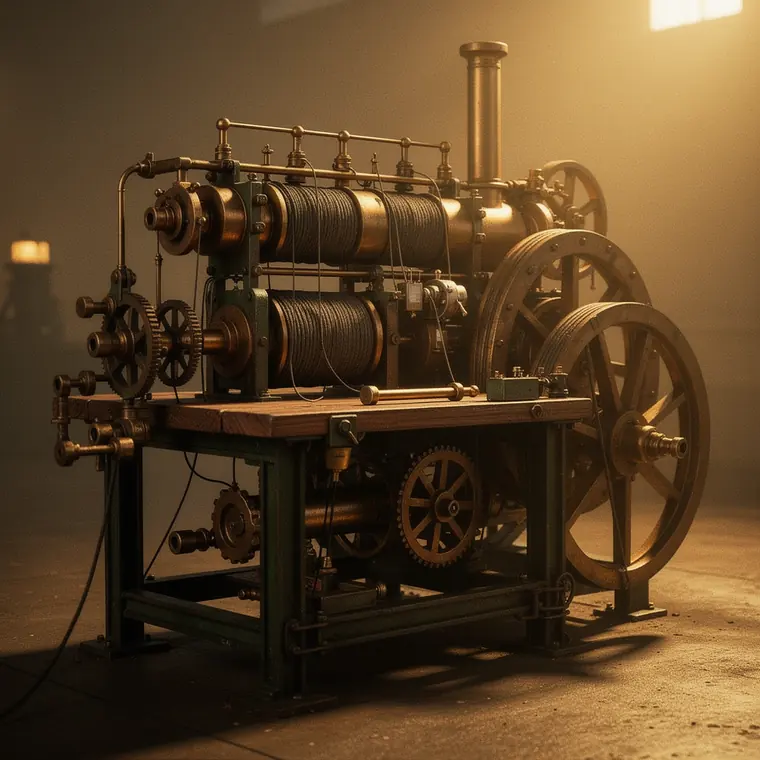
The cable ship Great Eastern hove to in mid Atlantic with paddle boxes and screw astern, the paying out gear on her after deck leading the cable over grooved sheaves past a dynamometer wheel.
- What it was used for
- A cable ship in the Atlantic, chartered by the Telegraph Construction and Maintenance Company. She had been built as a passenger steamer and failed as one; the telegraph museum PK Porthcurno records that when she was put up for sale at half her material cost there were no takers, until Daniel Gooch and his group bought her for 25,000 pounds. Paying out began off Valentia on 23 July 1865; on 2 August the cable parted after 1,212 miles had gone overboard (so engineer Canning's report; Bright: 1,186). In 1866 she sailed on 13 July and came into Heart's Content on 27 July, then grappled up the 1865 end and completed that line too: 1,896 miles long at an average depth of 1,900 fathoms. Bright and Field both put the successful cast of the grapnel at the thirtieth attempt.
- What was new
- One ship carried the whole cable. In 1857 and 1858 the load had been split between Niagara and Agamemnon, in 1858 spliced in mid-ocean; Charles Bright wrote in 1903 that this time it was determined the cable be laid "in one length, with the exception of the shore ends, by a single vessel". The barb hangs on the same hull: the ship whose size ruined her as a liner found, in Bright's words, her first useful work in cable laying, and afterwards ended as a showboat, concert hall and gymnasium and as a floating advertising hoarding on the Mersey before being broken up in 1889-90.
Connections
Every connection names its kind. “Forerunner” on its own would be a claim.
- Follows fromGreat Eastern1858The same hull, a second life. Field reports in 1866 that Brunel, pointing to the hull at Blackwall, told him: There is the ship to lay the Atlantic cable; ten years later she did. Too great for ordinary commerce as a liner, she was laid up in 1863; in 1864 Gooch, Brassey and Pender bought her for 25,000 pounds and chartered her to Telcon, which set three cable tanks into her hull.Source: Henry M. Field, The Story of the Atlantic Telegraph (1866), Volltext (Brunel in Blackwall; 'waiting for a mission'; drei Tanks) · History of the Atlantic Cable & Undersea Communications: Cableship Great Eastern (Auflegen 1863, Kauf 1864 für 25.000 Pfund, Charter an Telcon) · PK Porthcurno (Museum of Global Communications): The Great Eastern
- Works withSchaufelradmaschine der Great Eastern1858For the 1866 voyage the paddle engines were arranged so that they could be disconnected in five minutes. With one going ahead and the other backing, the ship could be held at rest or turned in her own length - a very important matter when it came to fishing the broken cable from the deep.Source: Henry M. Field, The Story of the Atlantic Telegraph (1892), Kap. XVI 'Victory at Last' (Project Gutenberg): Umbau der Schaufelradmaschinen vor der Fahrt von 1866