Cable Tank
1865 · Cable Tank · Work 136 of 1,871
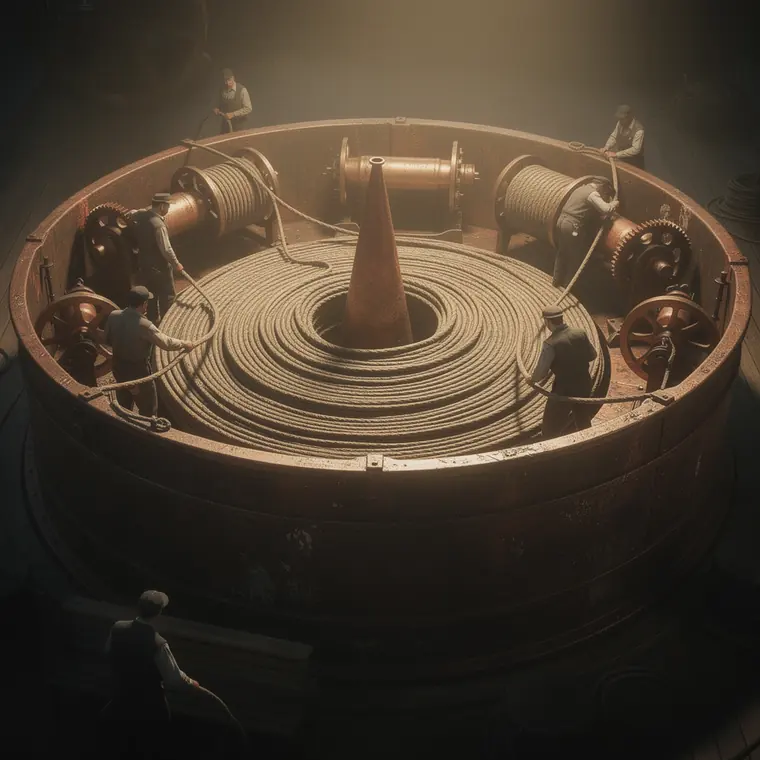
Men coiling armoured telegraph cable inside a circular iron tank aboard a cable ship, concentric flakes rising around the central cone while a coiler guides each turn by hand along the wall.
- What it was used for
- Three iron tanks in the Great Eastern's hull, holding the Atlantic cable under water. W. H. Russell gives the dimensions in 1865 - fore tank 51 ft 6 in diameter, middle 58 ft 6 in, after 58 ft, all 20 ft 6 in deep, together holding 2,490 miles of cable; George Elliot confirms them to the inch before the Institution of Mechanical Engineers in 1867. The water stood below the top flake and was let down through discharge valves as the cable ran out. Men stood in the tanks keeping the cable clear. Coiling aboard managed about two miles an hour, twenty a day, from 19 January into June 1865. At the Nore in late June 1865 the ship carried 21,000 tons.
- What was new
- The whole cable lay in one hull, kept wet and under continuous electrical test while stowed and while paying out. C. W. Siemens said in 1867, discussing Elliot's paper, he was glad watertight tanks had been adopted, a measure he had recommended for many years - his own attribution, not proof of priority; who designed the tanks is not stated in the sources checked. The barb came out of the tanks themselves: in 1865 a broken wire was found driven into the core, was taken for sabotage, the suspected gang was moved to other duties and gentlemen aboard kept watch in the tank by turns. In 1866 the same fault recurred and was traced, per Charles Bright, to the weight of the men bending the broken wire at right angles into the core. From the start of the 1866 voyage, per Field, the men worked cased in canvas and in slippers, without nailed boots.
Connections
Every connection names its kind. “Forerunner” on its own would be a claim.
- Works withKabelleger Great Eastern1866The tanks stood in the Great Eastern's hull on a bed of Portland cement three inches thick. Field explains the split into fore, middle and after tanks by the ship itself: a single dead weight amidships would have made her roll fearfully.Source: W. H. Russell, The Atlantic Telegraph (1865), Volltext (Project Gutenberg): Einbau der Tanks auf Portlandzement · Henry M. Field, The Story of the Atlantic Telegraph (1892), Kap. XIV 'The Expedition of 1865' (Project Gutenberg): Verteilung auf drei Tanks wegen der Rollbewegung