Hertz Spark Apparatus
1887 · Induction Coil · Work 146 of 1,871
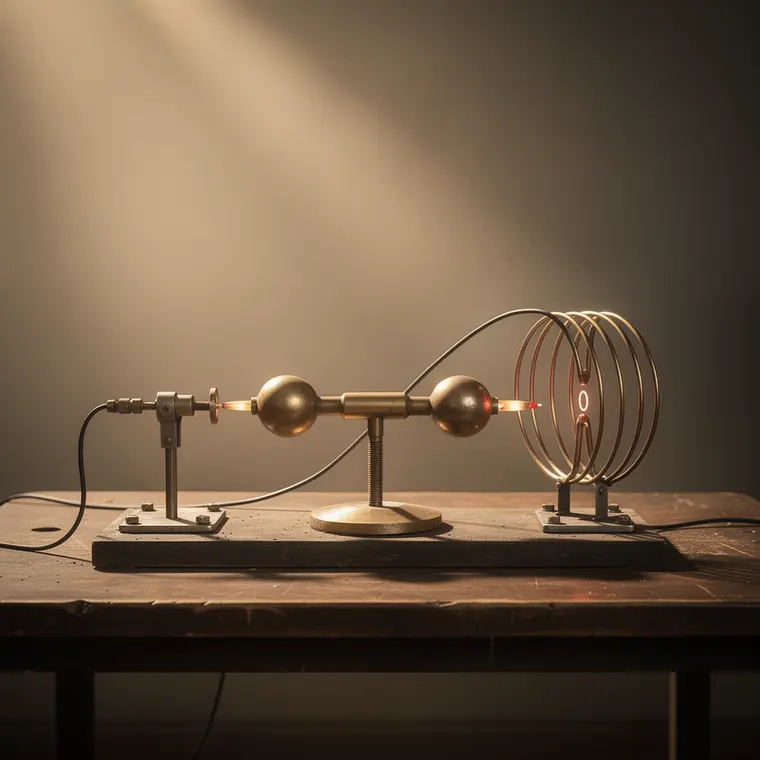
Hertz's spark apparatus in the Karlsruhe lecture room, an induction coil feeding two metal spheres on a straight rod while a wire ring resonator with a micrometer gap stands across the bench.
- What it was used for
- Hertz worked in a lecture hall of the Technische Hochschule Karlsruhe, about twelve metres square by his own account in a letter to FitzGerald of 20 July 1891, quoted by James G. O'Hara. He let a spark jump a gap in a dipole and, in the darkened room, looked for the tiny spark in the gap of a slotted wire ring which he moved about the hall as a receiver. He used the hall itself as an instrument: he reflected the waves off a wall and looked along the axis for the nodes of the standing wave. Per O'Hara the primary radiator was 2.6 metres of copper wire 5 millimetres thick with 30-centimetre zinc spheres at the ends, the receiver at first a square wire loop of 75-centimetre sides. Original pieces are in the Deutsches Museum, inv. 40060 and 40054.
- What was new
- What was new was not the waves but that one set-up could generate them, detect them at a distance in free space, and then make reflection, refraction, polarisation and velocity measurable; the IEEE Milestone plaque on the building lists exactly those four operations and gives 450 megahertz (ETHW's text: detection over 18 metres), KIT wavelengths of 30 to 100 centimetres. Oliver Lodge, by his own account, was working independently on the same subject in the spring of 1888, and draws the line himself: he regards the transmission of waves in free space as the special discovery of Hertz, while waves along wires are a much older thing. The barb is inside the proof. Hertz measured a different velocity along wires than in air and wrote to FitzGerald on 11 June 1888 that by Maxwell's theory both must be the velocity of light - a deviation he could not explain at all. Only Sarasin and de la Rive, in a large hall, found equal values; the cause, per O'Hara, stayed open.
Connections
Every connection names its kind. “Forerunner” on its own would be a claim.
- Follows fromRuhmkorff Coil1855The sparks came from a Ruhmkorff coil. O'Hara describes the primary circuit: 2.6 metres of copper wire, cut at the centre for a spark gap of under a centimetre, zinc spheres of 30 centimetres at the ends; across that gap were connected the poles of a large Ruhmkorff induction coil with a mercury make-and-break, powered by six large batteries. The coil supplied the high tension, the spark the wave.Source: James G. O'Hara, A 'Horrible Conflict with Theory' in Heinrich Hertz's Experiments on Electromagnetic Waves, European Review 15(4), 2007 (PDF; Beschreibung des Primärkreises mit Ruhmkorff-Induktor)
Further reading
- James G. O'Hara, A 'Horrible Conflict with Theory' in Heinrich Hertz's Experiments on Electromagnetic Waves, European Review 15(4), 2007, S. 545-559
- IEEE Milestone (ETHW): First Generation and Experimental Proof of Electromagnetic Waves, 1886-1888, Karlsruhe
- Deutsches Museum Digital, Inv. 40060: Kreisförmiger Resonator mit Messingspirale von H. Hertz
- Oliver J. Lodge, Signalling Across Space Without Wires, 3. Aufl., S. 3 und S. 43
- KIT, Presseinformation 153/2013: 125 Jahre 'Ueber Strahlen elektrischer Kraft' (Wellenlängen 30 bis 100 Zentimeter, 1000 bis 300 MHz)