Turbinia
1897 · Turbine Steamer · Work 194 of 1,871
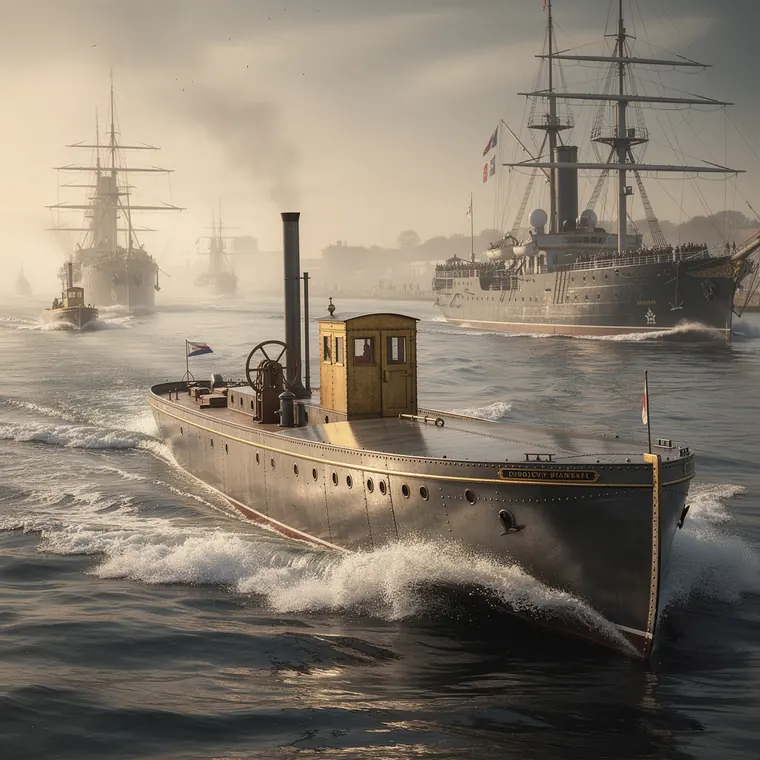
A narrow Victorian steam launch of the 1890s: a long very slender riveted steel hull about a hundred feet long and only nine feet wide, its deck low and almost flush with the water, one thin upright funnel amidships and a small conning tower forward of it, everything below the closed steel deck, running at extreme speed with a rearing bow, a massive bow wave and a high foaming wake astern, passing lines of anchored masted warships at a naval review.
- What it was used for
- Trials vessel and sales instrument of the Marine Steam Turbine Company formed in 1894; only the Parsons Marine Steam Turbine Company, formed after the fleet review, was, as the ASME landmark statement records, given the sole licence for building marine steam turbines; the same source says a comprehensive series of independent trials was run in April 1897 by Professor J. A. Ewing. Hull 100 feet long, the first installation planned for some 1,500 horsepower at 2,000 rpm; finally three shafts each carrying three 18-inch propellers, nine in all, later single screws of 28 inches. Her appearance was at the Diamond Jubilee fleet review at Spithead on 26 June 1897, before the Admiralty.
- What was new
- What was new was not the turbine but that a marine turbine could turn its revolutions into thrust: Parsons moved from a compound radial-flow turbine to three parallel-flow turbines with one compound stage, high, medium and low pressure, on each shaft (ASME). He built multistage reaction turbines where de Laval pursued the single-stage impulse design; Cyrus B. Meher-Homji gives Parsons's reasons as lower speeds needing no reduction gearing, higher efficiency and avoidance of steam erosion. The barb: her speed at the review is uncertain. The ASME statement records 29.6 knots over the measured mile in December, 32.76 in April 1897 and "over 34 knots" as a maximum, yet captions the review photograph "some 34 knots"; National Historic Ships says "over 30 knots", the Discovery Museum 34. The legend wobbles too: ASME writes she appeared "despite common belief to the contrary" with tacit approval, while Meher-Homji writes that Parsons "gate-crashed" the event.
Connections
Every connection names its kind. “Forerunner” on its own would be a claim.
- Follows fromParsons Steam Turbine1884Turbinia was built to test Parsons's own steam turbine at sea. The ASME landmark account dates his invention to 1884, when he filed "a patent for a compound reaction steam turbine"; in the following years lubrication, blade efficiency and control were solved and the turbine was applied to dynamos. Turbinia was launched in 1894.Source: ASME-Landmark: Turbinia, Engineering and Technology History Wiki · The Maritime Foundation (Richard Maudsley): Sir Charles Parsons and the birth of the steam turbine (Patent 1884)
Further reading
- ASME History and Heritage, National Historic Mechanical Engineering Landmark No. 73, Turbinia (1897)
- National Historic Ships UK, Register 138, Turbinia
- Discovery Museum / North East Museums, Turbinia
- Cyrus B. Meher-Homji, The Historical Evolution of Turbomachinery, Proceedings of the 29th Turbomachinery Symposium