Dorpat Refractor
1824 · Refracting Telescope · Work 205 of 1,871
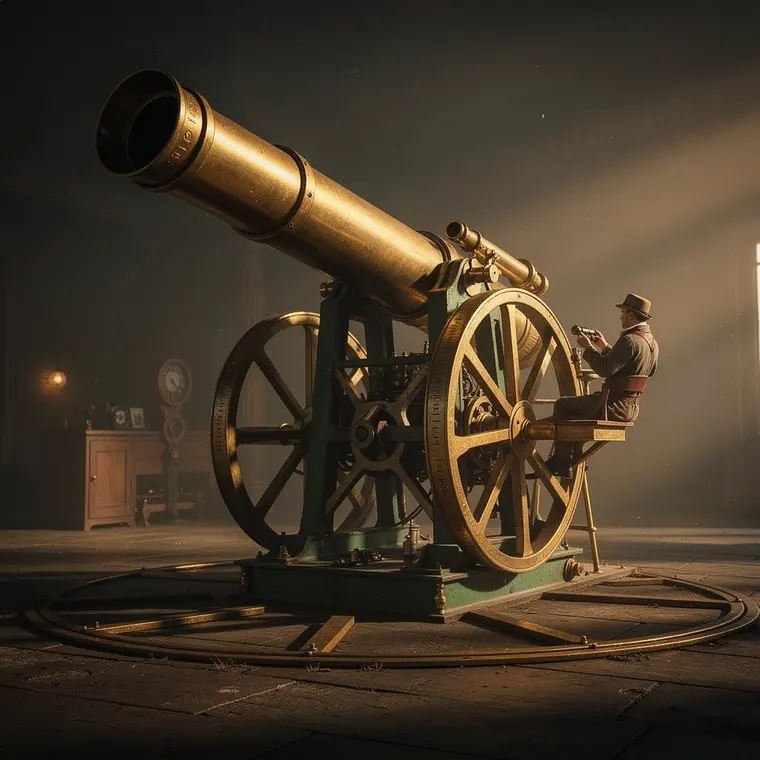
Fraunhofer's great refractor in the Dorpat observatory, its brass tube on a counterweighted German equatorial mount driven by falling weight clockwork, astronomer seated at the eyepiece.
- What it was used for
- Friedrich Georg Wilhelm Struve, director of the Dorpat observatory (now Tartu, Estonia), used the refractor for double stars and stellar distances. He had ordered it from Fraunhofer in Munich in 1817; on 10 November 1824, 22 crates arrived in Dorpat, and five days later Struve made his first observations. His 1827 catalogue listed 3,112 double stars, found among some 120,000 stars of the northern sky. He also used it to measure the parallax of Vega. In 1837 he gave 0.125 arcseconds, close to today's value of 0.130. With more measurements he revised this around 1840 to 0.261, twice the true figure. Reid and Menten showed in 2020 that the first value was right only by chance: two measurement directions gave clearly different parallaxes on their own.
- What was new
- Fraunhofer's objective had an aperture of 24.4 cm and a focal length of 4.34 m; the UNESCO Portal to the Heritage of Astronomy calls it the best and largest refractor of its time. It also had an equatorial mounting, later known as the "German mounting", and a clockwork drive that turned the telescope with the sky. A star therefore stayed in the field while Struve measured separations and angles with the micrometer. Whether Dorpat had the first clock-driven telescope cannot be established from the sources checked. Several people were working on stellar parallax at once: Bessel in Königsberg published the parallax of 61 Cygni in 1838, measured with a heliometer also made by Fraunhofer. Struve had given his tentative value in 1837; Bessel's is usually regarded as the first reliable measurement.
Connections
Every connection names its kind. “Forerunner” on its own would be a claim.
- Follows fromBenediktbeuern Spectrometer1814Fraunhofer used the dark lines to determine the refraction and dispersion of his glasses; the title of his 1817 paper states the purpose: towards the perfection of achromatic telescopes. According to the Fraunhofer-Gesellschaft this allowed the refractive indices needed for achromatic lenses to be computed precisely. In 1819 the Dorpat objective was made, the largest produced to date.Source: Joseph Fraunhofer, Bestimmung des Brechungs- und Farbenzerstreuungs-Vermögens verschiedener Glasarten, in Bezug auf die Vervollkommnung achromatischer Fernröhre (1817), Digitalisat der Bayerischen Staatsbibliothek · Fraunhofer-Gesellschaft, Fraunhofer in Benediktbeuern: Glassworks and Workshop (PDF)
Further reading
- The Fraunhofer Refractor of Tartu (Dorpat) and its Restoration (academia.edu)
- Universität Tartu, Museum: Exhibition „Two Boys who Dreamed of Stars. Struve, Fraunhofer and the 200-Year-Old Telescope“
- UNESCO/IAU Portal to the Heritage of Astronomy: Tartu Observatory, Estonia
- Reid, M. J.; Menten, K. M.: The First Stellar Parallaxes Revisited (arXiv:2009.11913, 2020)
- American Astronomical Society: This Month in Astronomical History, November 2021
- ESA: A history of astrometry – Part II. Telescope ignites the race to measure stellar distances
- Astronomy Magazine: Struve's stars