Heidelberg Student Laboratory
1855 · Bunsen Burner · Work 227 of 1,871
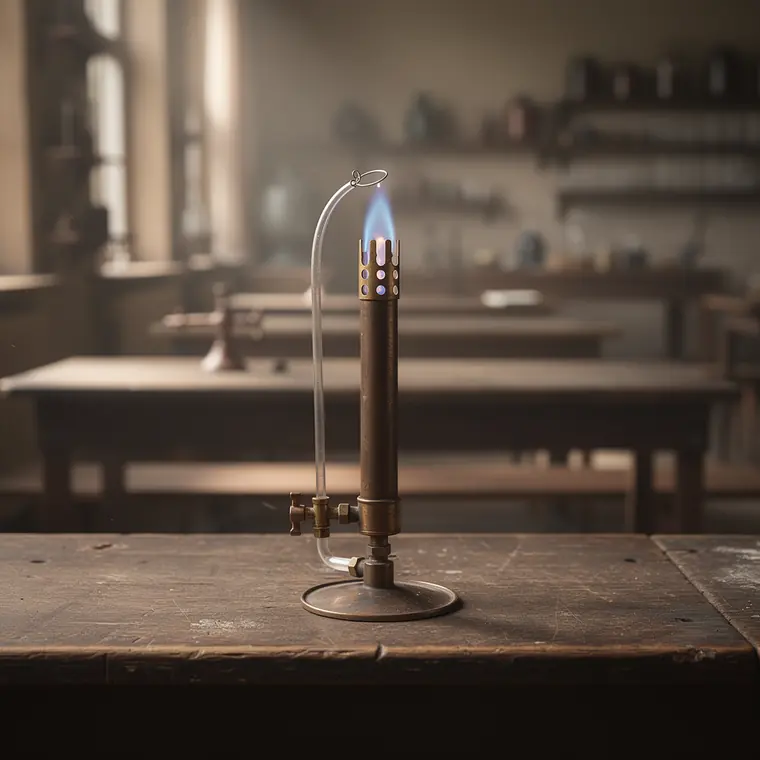
A Bunsen burner clamped at a bench in the Heidelberg student laboratory: a plain upright metal tube no thicker than a finger standing on a flat heavy metal foot, a gas supply pipe entering at the bottom, an air collar with holes open around the base of the tube, and a pale blue flame issuing from the open top of the tube, rows of benches behind, a platinum wire loop held in the flame.
- What it was used for
- Robert Bunsen had a new chemical laboratory built in Heidelberg because the old space was too small; the architect was Heinrich Lang. Building began in May 1854 at the corner of Akademiestraße and Plöck, and the laboratory was working by the summer semester of 1855. According to the German Chemical Society (GDCh), it cost more than 76,000 gulden. It had 50 student workplaces, a lecture hall with 110 seats, a room for work with hydrogen sulphide and an open hall for toxic gases. It was full from summer 1856 and was first extended in 1859, when 60 people were already working in it. The building was connected to the town's newly introduced gas supply. Bunsen worked there until 1889.
- What was new
- Heidelberg University calls the building the best German university laboratory of its time. The Bunsen burner comes from this laboratory. Laboratory gas burners existed before; Michael Faraday described one in 1827. According to William B. Jensen, Bunsen's burner was in use in the laboratory from 1855 but was described in detail only in 1857, with Henry Roscoe. The university instrument maker Peter Desaga built it in simplified form. Priority was contested: the Berlin firm Julius Pintsch (1855) and the lighting engineer R. W. Elsner (1856) made claims, which Desaga successfully contested according to Jensen, and Roscoe later traced the burner to a gauze burner he had brought from England. According to Joe Schwarcz (McGill University), Bunsen never patented the burner.
Connections
Every connection names its kind. “Forerunner” on its own would be a claim.
- Works withKirchhoff Bunsen Spectroscope1860The burner is a component of the spectral apparatus. In the 1860 paper the lamp stands before the slit so that the rim of the flame lies on the axis of the slit tube, and a platinum wire loop holds the sample in the flame. Kirchhoff and Bunsen justify the choice by the flame's high temperature and low luminosity.Source: Kirchhoff & Bunsen, Chemical Analysis by Observation of Spectra, Annalen der Physik und der Chemie 110 (1860), S. 161-189, englische Übersetzung (ChemTeam) · Linda Hall Library, Scientist of the Day: Gustav Kirchhoff
Further reading
- GDCh, Historische Stätten der Chemie: Robert Wilhelm Bunsen und sein Heidelberger Laboratorium
- Pharmazeutische Zeitung 44/2011, Historische Stätte der Chemie
- Universität Heidelberg, Fakultät für Chemie und Geowissenschaften, Sightseeing mit Bunsen
- William B. Jensen, The Origin of the Bunsen Burner, J. Chem. Educ. 82 (2005) 518
- McGill Office for Science and Society, National Bunsen Burner Day