Kirchhoff Bunsen Spectroscope
1860 · Spectroscope · Work 228 of 1,871
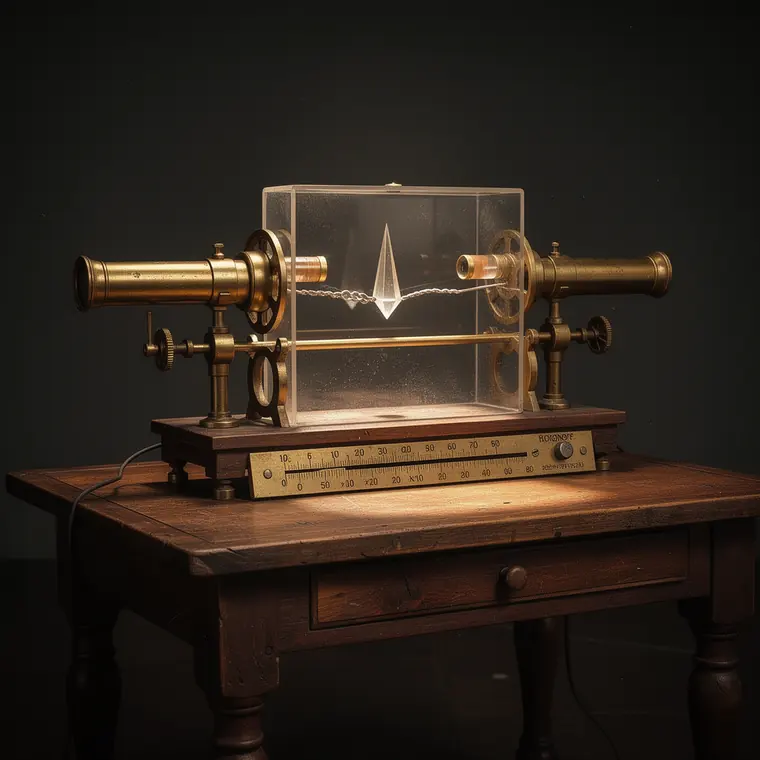
The Kirchhoff and Bunsen spectroscope on a Heidelberg bench, a prism under a cover between two brass telescope tubes, a burner with a salt loop set at the slit.
- What it was used for
- The chemist Robert Bunsen and the physicist Gustav Kirchhoff used the spectroscope at Heidelberg University from 1859. They put samples into a flame and identified the elements from the coloured lines of their spectra. They published the method in 1860 and 1861 as "Chemische Analyse durch Spectralbeobachtungen" in Poggendorff's Annalen. With it they found caesium in Dürkheim mineral water in 1860 and rubidium in 1861. According to an 1861 notice in the American Journal of Science on Bunsen's preliminary communication, 10 kg of Dürkheim water held not quite 2 mg of caesium chloride. To obtain weighable amounts, Bunsen evaporated water on a large scale; Heidelberg University gives 30 tonnes, other sources 40.
- What was new
- The instrument itself was not new in principle; Bunsen and Kirchhoff combined known techniques, and Fraunhofer had described the dark lines in the solar spectrum in 1814. What was new was the finding that each element shows its own pattern of lines and can be detected in traces that no chemical reaction would reveal. Kirchhoff produced Fraunhofer lines artificially at exactly the same place in the spectrum; this made statements about the chemical composition of the Sun possible. In 1835 Auguste Comte had written in his "Cours de philosophie positive" that the chemical composition of the stars could never be studied by any means. About 25 years later that is exactly what happened.
Connections
Every connection names its kind. “Forerunner” on its own would be a claim.
- Follows fromBenediktbeuern Spectrometer1814On their 1860 plate Kirchhoff and Bunsen drew a line connecting sodium's yellow double line to the dark D line of the solar spectrum, suggesting sodium in the Sun's atmosphere. Fraunhofer had discovered and drawn those dark lines in 1814; in the paper they serve as reference marks, for instance line A for potassium.Source: Linda Hall Library, Scientist of the Day: Gustav Kirchhoff · Deutsches Museum Blog, Brechung und Berechnung. Joseph Fraunhofer und das Spektrum der Sonne · Kirchhoff & Bunsen, Chemical Analysis by Observation of Spectra, Annalen der Physik und der Chemie 110 (1860), S. 161-189, englische Übersetzung (ChemTeam)
Further reading
- Universität Heidelberg, Geschichte der Chemie in Heidelberg
- Marshall & Marshall, Mineral Waters and Spectroscopy, The HEXAGON (2008)
- Cæsium and Rubidium, Notiz im American Journal of Science (Nov. 1861) über Bunsens Mitteilung, Text bei Today in Science History
- DPMA, Gustav Robert Kirchhoff
- Comte, Cours de philosophie positive, Bd. 2, 19. Lektion (Project Gutenberg)
- Science History Institute, Robert Bunsen and Gustav Kirchhoff