Giessen Teaching Laboratory
1842 · Analytical Laboratory · Work 229 of 1,871
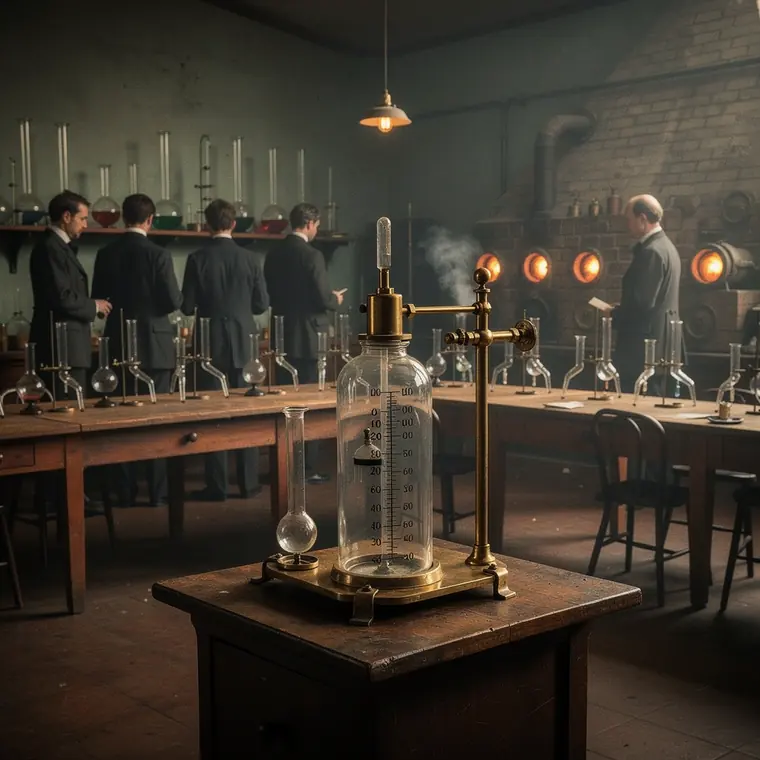
Justus von Liebig's teaching laboratory at Giessen, students standing at a ring of work tables with retort stands and flues, a furnace bench along the far wall.
- What it was used for
- Justus Liebig was professor at Giessen from 1824 to 1852 and trained chemists and pharmacists in the laboratory. Students first practised qualitative analysis and later did research with the professor. The laboratory was in the former guardhouse of a barracks. Liebig began there on 7 November 1824 with 12 students; the rooms soon became too small, and in 1839/40 a cross wing with laboratories, a library and a lecture hall was added. The date 1842 belongs to a lithograph: the interior of the analytical laboratory after drawings by Wilhelm Trautschold and Hugo von Ritgen, published in J. P. Hofmann's book on the Giessen laboratory. The Wellcome Collection dates the print, with a question mark, to about 1840.
- What was new
- What was new was that teaching and research took place in the same room. According to the historian of science Henning Schmidgen, the benches stood free in the room rather than along the walls, so more students could work at once. The 1842 image shows men from several countries working together. It was not the first teaching laboratory: Thomas Thomson taught practical chemistry in Glasgow by 1818 at the latest, and some of his students later went on to Liebig for further training. The historian Alan Rocke explains Giessen's success less by Liebig's person than by three things in organic chemistry: the discovery of isomers, formulas used as "paper tools", and the Kaliapparat.
Connections
Every connection names its kind. “Forerunner” on its own would be a claim.
- Works withLiebig Kaliapparat1831According to the historian Catherine Jackson, Liebig used the Kaliapparat to build a system of large-scale practical training at Giessen; with large teams of students, C&EN writes, he could outperform his competitors in France and England. As the story goes, the device was easy enough for beginners to master, multiplying the number of analyses per week or month.Source: C&EN / American Chemical Society, A Most Important Artifact (über den Kaliapparat), 7. September 2015 · ACS Division of the History of Chemistry, Faksimile desselben Beitrags (PDF)
Further reading
- Liebig-Museum Gießen, Geschichte
- Das Liebig-Museum in Gießen (PDF, Deutsche Nationalbibliothek)
- Henning Schmidgen, Laboratory, Encyclopedia of the History of Science
- Wellcome Collection, Innere Ansicht des analytischen Laboratoriums zu Giessen
- Complete Dictionary of Scientific Biography, Thomson, Thomas (Encyclopedia.com)
- Alan Rocke, Origins and spread of the Giessen model in university science (Cambridge UP, Abstract)
- GDCh, Historische Stätten der Chemie: Justus von Liebig, Gießen (2003)