Mendeleev Wall Chart
1869 · Periodic Table · Work 231 of 1,871
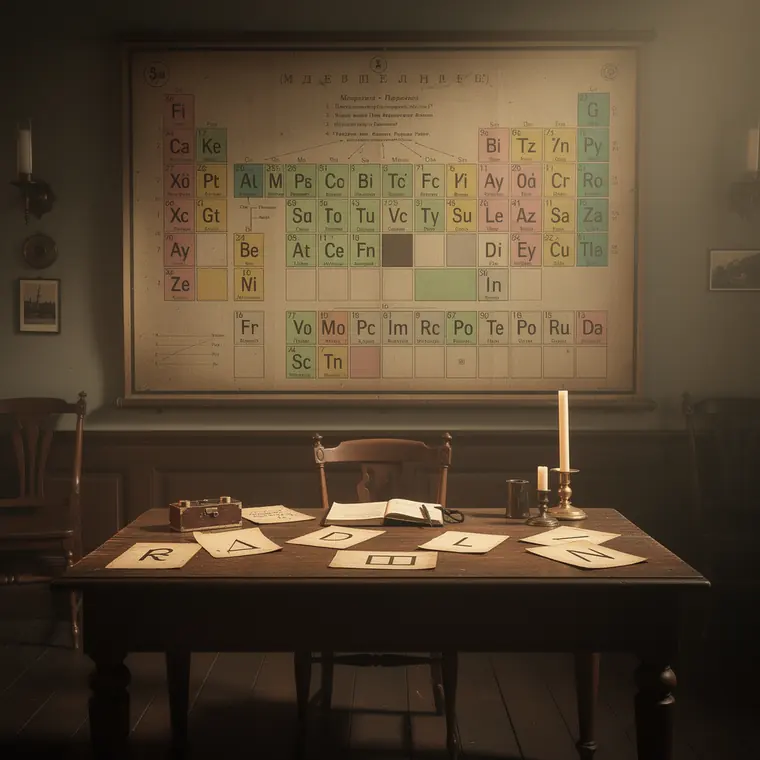
Mendeleev's periodic table drawn on a large wall chart in a Saint Petersburg lecture room, handwritten element cards spread across the demonstration desk below with gaps left open.
- What it was used for
- Mendeleev arranged the 63 elements then known by atomic weight and chemical kinship, first as a framework for his textbook in St Petersburg. The table was presented to the Russian Chemical Society on 6 March 1869 (Julian; 18 March Gregorian) by a colleague, as Mendeleev was ill. It was printed in 1869 in the society's journal, with a German abstract in the Zeitschrift für Chemie. As a wall chart the system served chemistry teaching: the chart thought to be the oldest in the world belonged to Thomas Purdie at St Andrews. Printed in Vienna by Lenoir & Forster and dated to 1885, it was bought, according to university records, in October 1888 for 3 marks from a German catalogue.
- What was new
- Periodic arrangements existed before: de Chancourtois' screw of 1862, Newlands' law of octaves of 1865, Lothar Meyer's tables from 1864. What Mendeleev added was deliberate gaps, with question marks at atomic weights 45, 68 and 70, and, in later publications, detailed predictions of the missing elements' properties. Gallium (1875), scandium (1879) and germanium (1886) filled them. The twist: the St Andrews chart turned up in 2014 during a clear-out of a chemistry storeroom; Eric Scerri dated it by its elements: gallium and scandium are present, germanium is missing, hence 1879 to 1886.
Connections
Every connection names its kind. “Forerunner” on its own would be a claim.
- Follows fromKirchhoff Bunsen Spectroscope1860Mendeleev's 1869 table carries Rb = 85.4 and Cs = 133 in the alkali row, and his second conclusion cites K, Rb, Cs as elements whose atomic weights rise by equal steps. Bunsen and Kirchhoff had found both with the Heidelberg spectroscope, caesium in 1860 and rubidium in 1861.Source: D. Mendelejeff, Zeitschrift für Chemie 12 (1869), S. 405-406, Übersetzung und Tabelle bei Carmen Giunta, Le Moyne College · Royal Society of Chemistry, Periodic Table: Rubidium (Entdeckung durch Bunsen und Kirchhoff mit dem Spektroskop) · Science History Institute, Robert Bunsen and Gustav Kirchhoff
Further reading
- University of St Andrews: World's oldest periodic table chart found in St Andrews
- Chemistry World: Is this the world's oldest classroom periodic table?
- AIP: A look at the first published periodic table
- Le Moyne College (C. Giunta): Mendeleev's First Periodic Table, annotated
- OUPblog: Mendeleev's Periodic Table presented in public
- Royal Society of Chemistry: Development of the periodic table