Peugeot Type 3
1891 · Vis-a-Vis with Frame Cooling · Work 250 of 1,871
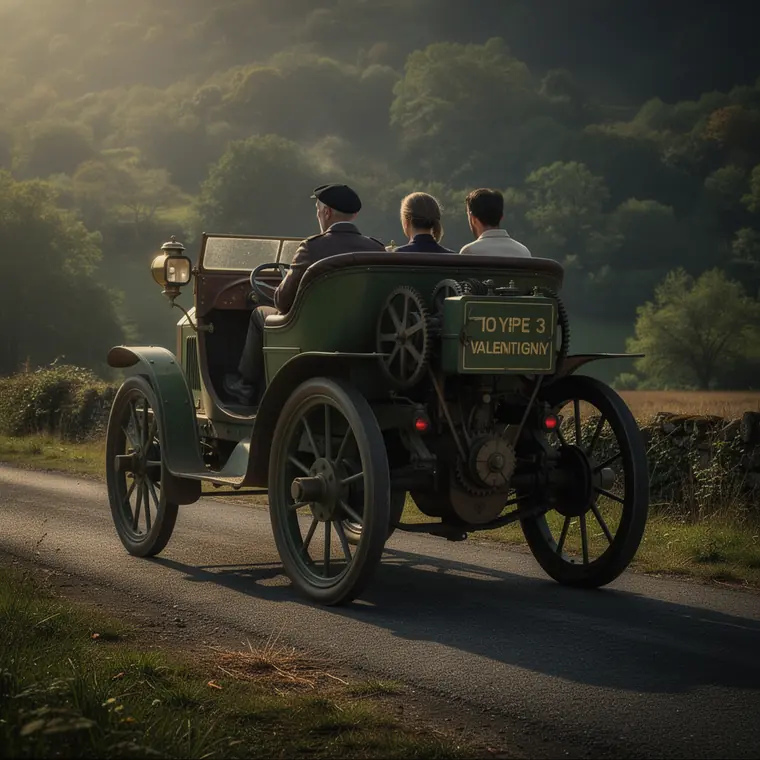
A Peugeot Type 3 vis-a-vis on a rural road near Valentigney, passengers facing each other, Daimler licensed V-twin at the rear, cooling water circulating through the tubular frame itself.
- What it was used for
- According to the Musée des Arts et Métiers, the Type 3 was Peugeot's first series car, built in 64 examples at the Valentigney works. The Paris example, no. 13, went to Henri Menier in 1892, who had a radiator fitted; MAUTO in Turin holds no. 25, ordered on 30 August 1892. In September 1891 engineer Louis Rigoulot and mechanic Auguste Doriot drove one alongside the Paris–Brest–Paris cycle race. According to the association L'Aventure Peugeot the car averaged 14.7 km/h – the winning cyclist, Charles Terront, 16.9 km/h. The total distance including the trip to and from Valentigney is disputed: L'Automobile Ancienne gives 2,045 km, L'Aventure Peugeot about 2,500 km.
- What was new
- For Peugeot the Type 3 was the step to series production: according to Arts et Métiers only four of the preceding Type 2 were sold in 1891. Technically little was its own. The 565 cc V-twin was a Daimler design built by Panhard & Levassor, the licensee and a competitor. Series production was not new in 1891 either; Panhard & Levassor was delivering cars the same year. Output is given as 2 hp (MAUTO, L'Automobile Ancienne) or 2.5 hp (L'Aventure Peugeot).
Connections
Every connection names its kind. “Forerunner” on its own would be a claim.
- Follows fromMaybach Stahlradwagen1889The Type 3 carries a Daimler two-cylinder V engine of 565 cc at the rear; MAUTO Turin records it as "motore della fabbrica tedesca Daimler n. 124". It is the engine type of the steel-wheeled car; according to MAUTO, Armand Peugeot made his agreement with the licensee Levassor on the occasion of the 1889 Paris exposition.Source: MAUTO, Museo Nazionale dell'Automobile Torino: Storia, tecnica e stile Peugeot tipo 3 · MAUTO, Museo Nazionale dell'Automobile Torino: Storia della Peugeot · Mercedes-Benz Public Archive: Daimler wire-wheel car, 1889
Further reading
- Musée des Arts et Métiers: Quadricycle Peugeot Type 3
- MAUTO Museo Nazionale dell'Automobile: Peugeot Type 3
- L'Aventure Peugeot: The Peugeot Type 3 took part in the Paris-Brest-Paris race
- L'Automobile Ancienne: Peugeot Type 3
- Château de Compiègne: Phaéton automobile Panhard & Levassor (Auslieferungen Okt.-Dez. 1891)