Arkwright Carding Engine
1775 · Carding Engine · Work 288 of 1,871
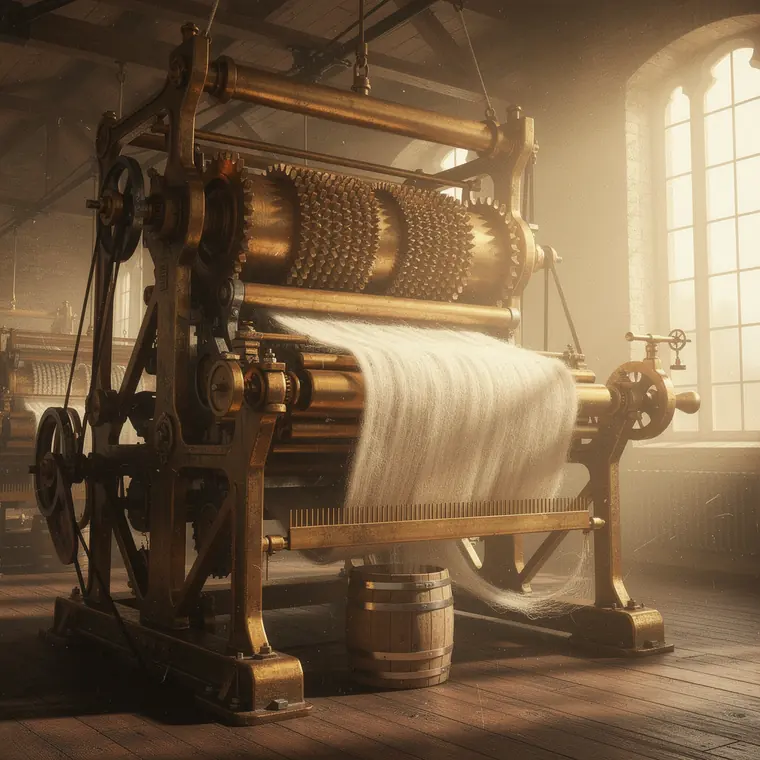
Arkwright's carding engine in a spinning mill, a large toothed cylinder meeting smaller rollers, the crank comb stripping a continuous fleece web down into a funnel and can.
- What it was used for
- The card was the stage before the water frame, and Arkwright's patent of 1775 also covered drawing and roving machines. The Science Museum Group holds a carding machine by Arkwright of about 1775, believed to come from Cromford Mill: three cylinders running at different speeds, the main cylinder about eighty times the licker-in, the doffer at a tenth with its teeth set the opposite way. Baines describes the result: at one end the cotton went in an entangled, knotted mass, at the other it came out an even, delicate film and was at once compressed into a continuous sliver, ready for the spinner. The patent fell on 25 June 1785 before King's Bench on a writ of scire facias; the jury found for the Crown "without a minute's hesitation".
- What was new
- Patent no. 1111 was sealed on 16 December 1775, the specification on 10 April 1776. What was new was not the carding cylinder - Lewis Paul, no. 636 of 1748 - nor the roller card - Daniel Bourn, no. 628 of 1748 - nor the endless feeding cloth, which John Lees made in 1772 and claimed in 1785. What was new was that the film is no longer taken off by a loose comb with the machine stopped, but runs off as a continuous sliver from a comb fixed to the machine and worked by a crank; the Smithsonian Institution calls this comb ("a crank and a frame of iron with teeth") the most important single feature. In 1785 Hargreaves's widow, his son and the smith George Whitaker, who had made "near twenty" of them, swore it was James Hargreaves's work, used openly since 1773. The Science Museum Group today attributes the comb to Hargreaves; Baines reached the same conclusion in 1835 and reversed himself just before the sheets went to press, on a single statement by the son of Hargreaves's partner.
Connections
Every connection names its kind. “Forerunner” on its own would be a claim.
- Works withWater Frame1769Baines 1835: the card takes in cotton as an entangled mass and delivers an even sliver, ready for the spinner; the drawing and roving frames rest on exactly the same principles as Arkwright's spinning frame of 1769. The water frame, the carding engine and Arkwright's other machines together required strongly built mills turned by water.Source: Edward Baines, History of the Cotton Manufacture in Great Britain, London 1835, S. 179-184
- Works withCromford Mill1771The Science Museum records a carding machine by Arkwright of about 1775 as "believed to be from Cromford Mill, Derbyshire" - a belief, not proof. According to the Derwent Valley Mills Partnership, Arkwright perfected the mechanisation of the pre-spinning processes between 1772 and 1775, the core of his 1775 patent, and put it into operation in his second Cromford mill, built in 1776-77.Source: Science Museum Group Collection: Carding machine by Richard Arkwright, 1775, believed to be from Cromford Mill, Derbyshire (co44551, Objektnr. 1860-7) · Derwent Valley Mills World Heritage Site: Key Sites – Cromford Mill · UNESCO World Heritage Centre, Derwent Valley Mills (Ref. 1030)
Further reading
- The trial of a cause instituted by Richard Pepper Arden ... to repeal a patent granted on the sixteenth of December 1775, to Mr. Richard Arkwright, London 1785
- Grace L. Rogers, The Scholfield Wool-Carding Machines, Smithsonian, Contributions from the Museum of History and Technology, Paper 1
- Science Museum Group Collection: Carding machine by Richard Arkwright, 1775, believed to be from Cromford Mill
- Edward Baines, History of the Cotton Manufacture in Great Britain, 1835 (Pauls Karde und ihre Mängel; crank and comb; Selbstwiderruf)
- Great Britain Patent Office (Woodcroft), Titles of Patents of Invention 1617-1852, Part I (Nr. 1111, Nr. 636, Nr. 628)