Roberts Self-Actor
1825 · Self-Acting Mule · Work 292 of 1,871
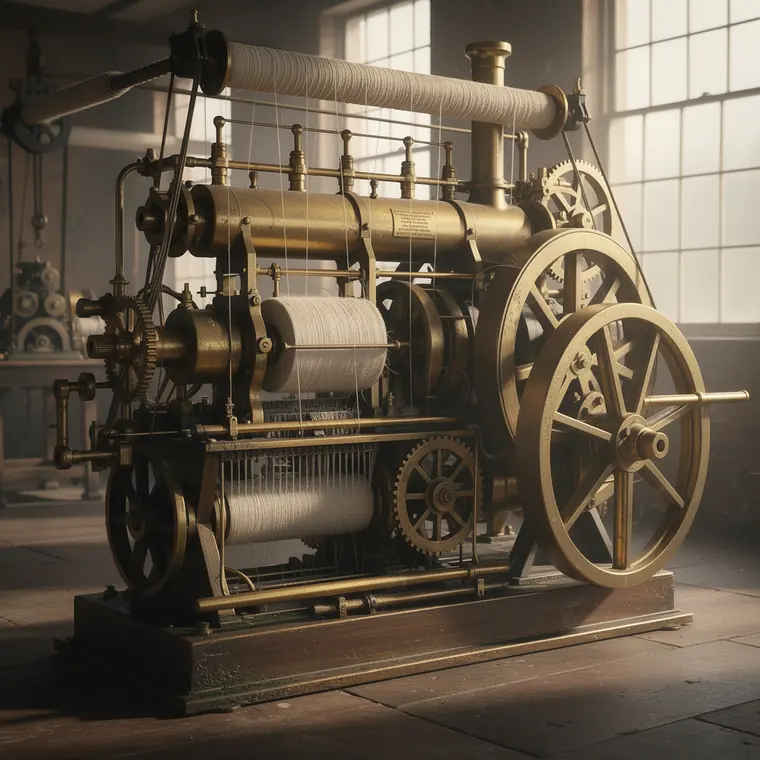
Richard Roberts' self-acting mule in a Manchester spinning room, the quadrant and scroll gear governing the carriage as it runs back, faller wires laying yarn onto cops.
- What it was used for
- Cotton spinning mills in Lancashire. During a mule spinners' strike at Hyde and Stalybridge, mill owners asked the Manchester firm Sharp, Roberts & Co for a self-acting mule. Roberts altered almost nothing but the headstock, so existing mules could be converted. A newspaper report described the trial on a mule of 120 spindles (Leeds Intelligencer, 17 November 1825). In March 1834 the patentees told Edward Baines they had built 520 self-acting mules carrying more than 200,000 spindles. Baines states one selling point plainly: the machine made masters independent of the working spinners, whose stoppages had often annoyed them. Two years later the Preston Chronicle reported that the chief object of the conversion Preston masters were considering was to employ adults, such as hand-weavers, as piecers, partly to make up the shortage caused by the last Factory Act's restriction on younger workers.
- What was new
- Self-acting mules were not new. In 1835 Baines lists Strutt, Kelly, Eaton, Ewart, De Iongh, Buchanan, Knowles and Brewster; none succeeded to any considerable extent, though De Iongh's mule had been worked with advantage in several mills. What the 1825 patent added was the counter faller: a second faller wire below the yarn that rises as the upper one descends during backing off, so the yarn never slackens. Montgomery in 1836 calls this the first successful effort towards an entirely self-acting mule. Regulation of spindle speed during winding on, matched to the growing diameter of the cop, was according to Montgomery likewise covered by Roberts' two patents. According to the Leeds Intelligencer, Maurice de Jongh was granted his patent on the same day as Roberts; according to Montgomery his mules were later fitted with Roberts' counter faller, without which they were not in reality self-acting.
Connections
Every connection names its kind. “Forerunner” on its own would be a claim.
- Follows fromCrompton Mule1779According to a newspaper report of 1825, Roberts's improvements were confined, with very trifling exceptions, to the headstock of the mule; the rollers, spindles and body of the mule were not altered. Old mules could be converted by replacing their headstocks with ones on Roberts's plan. Patented March 1825. The 1825 machine was not successful; an improved one was patented in 1830.Source: Grace's Guide: Richard Roberts: Self-acting Spinning Mule · Science Museum Group, Richard Roberts
Further reading
- Edward Baines, History of the Cotton Manufacture in Great Britain, London 1835, S. 206-208
- James Montgomery, The Theory and Practice of Cotton Spinning, Glasgow 1836, S. 196-208
- Grace's Guide: Richard Roberts - Self-acting Spinning Mule (Abdruck Leeds Intelligencer 17.11.1825, Northern Whig 17.12.1836)
- Science Museum Group, Personeneintrag Richard Roberts
- Andrew Ure: The Philosophy of Manufactures, London 1835, S. 366-367, archive.org