Crompton Mule
1779 · Spinning Mule · Work 289 of 1,871
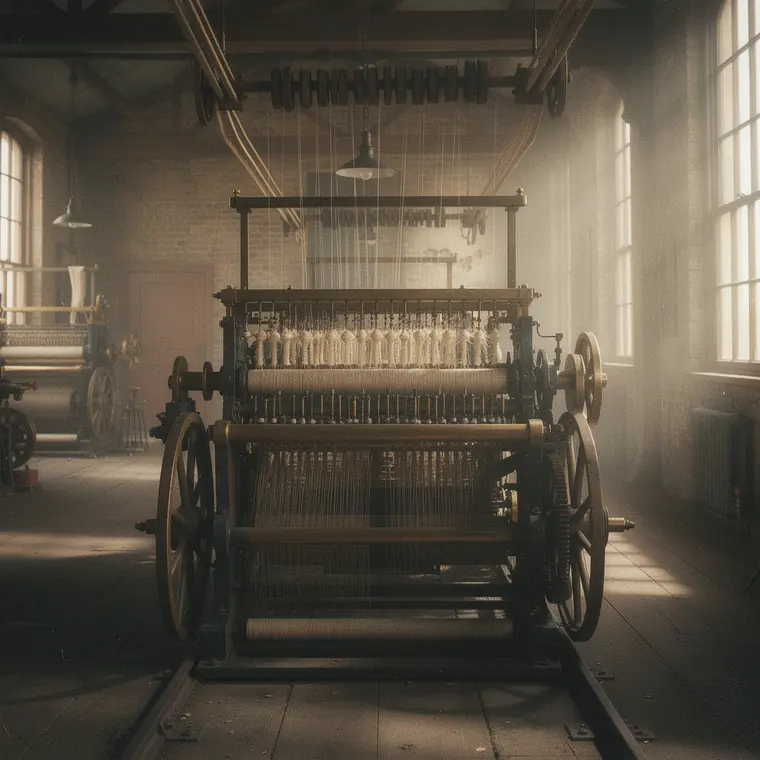
Samuel Crompton's spinning mule in a Bolton attic, its wheeled carriage rolled outward on rails away from the roller beam, dozens of spindles drawing fine yarn.
- What it was used for
- Samuel Crompton span first himself, with his wife, at Hall i' th' Wood near Bolton, and by French's account "with the greatest possible privacy", small quantities of the coveted fine yarn; later he was a cotton spinner in King Street, Great Bolton. The yarn was wanted as weft for muslin. On the counts there is a figure from Crompton himself, passed through three hands: 14 shillings a pound for No. 40, soon after 25 shillings for No. 60, and 42 shillings for a small quantity of No. 80, which he span only to show that it was possible. Baines wrote in 1835 that as many as 350 hanks to the pound had since been spun, each of 840 yards, together 167 miles of thread from one pound. Crompton died on 26 June 1827 in King Street; Bolton Library and Museum Services state that his debts exceeded assets valued at only £25.
- What was new
- The machine combined Arkwright's drawing rollers with the reciprocating carriage of the jenny, and from that the secondary sources explain the name; no contemporary eighteenth-century source for this etymology has been traced. A Bolton memorial of May 1825 (in French) calls it first "Hall-in-the-Wood wheels" and only "since by the appellation of 'the mule'". What it could do beyond its two parents can be read from Crompton's own petition to Parliament: mule yarn depressed the price of "sixty hanks water-frame twist", so the water frame reached No. 60 and the mule's advantage lay above that. The Science Museum Group dates the invention to the period 1772 to 1779, not to the year 1779. Crompton took out no patent: Grace's Guide gives want of means, while Bolton Library and Museum Services write that he was persuaded not to try because Arkwright defended his patents vigorously - both are documented, and neither may be called "the reason".
Connections
Every connection names its kind. “Forerunner” on its own would be a claim.
- Follows fromSpinning Jenny1764French 1859: at sixteen Crompton spun on a jenny of eight spindles and kept at it for the following five years; in the mule he wedded roller drafting to Hargreaves's jenny-wheel. Baines 1835: like the jenny, the mule has spindles without bobbins; but instead of the clasp holding the rovings being drawn back, the spindles recede on a carriage.Source: Gilbert J. French, The Life and Times of Samuel Crompton, Manchester 1859, S. 35 und 67 (Volltext) · Edward Baines, History of the Cotton Manufacture in Great Britain, London 1835, S. 197-198
- Parallel toWater Frame1769John Kennedy 1830, printed by French 1859: Crompton added a second, slower pair of rollers, “a modification of Mr. Arkwright's roller beam”; yet Crompton often told him that when he built his machine he knew nothing of Arkwright's discovery. French concludes that, with a mere hint that rollers were used, Crompton re-invented the system.Source: Gilbert J. French, The Life and Times of Samuel Crompton, Manchester 1859, S. 65-67 (Volltext; zitiert John Kennedys Vortrag von 1830)
- Works withMill Rotative Engine1782Grace's Guide: John Kennedy and James McConnel were mule-spinning from 1791 and for many years the sole makers of Crompton's mule; for their Old Mill in Ancoats they ordered a 16 HP engine from Boulton and Watt in June 1797. According to the history "City of Capital and Labour", they and the brothers Adam and George Murray applied Boulton and Watt's rotary beam engine to drive the mule.Source: City of Capital and Labour, Kapitel 2: The 'Shock City' of Industrial Capitalism, c.1780-c.1840, Open Book Publishers 2025 (Tom Saunders) · Grace's Guide to British Industrial History: McConnel and Kennedy
Further reading
- Gilbert J. French, The Life and Times of Samuel Crompton, 1859 (Garnnummern, Subskription, Petitionstext, Tod 26.6.1827)
- Science Museum Group Collection: Replica of Crompton's Mule spinning frame (Datierung 1772-1779, etwa 144 Spindeln)
- Bolton Library and Museum Services: The life of Samuel Crompton
- Grace's Guide: Samuel Crompton
- Edward Baines: History of the Cotton Manufacture in Great Britain (1835), archive.org