Radcliffe Dressing Frame
1803 · Sizing Machine · Work 298 of 1,871
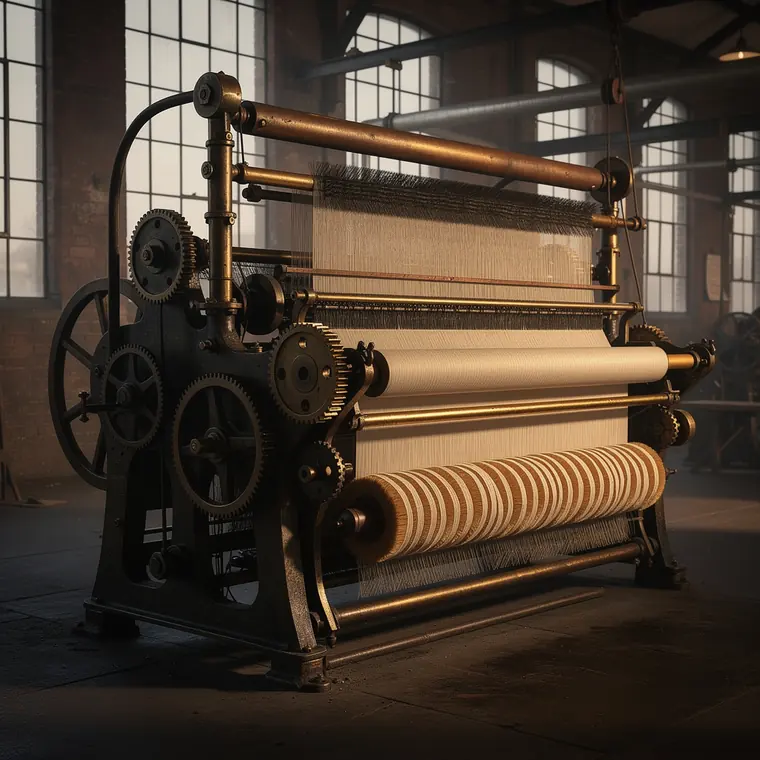
William Radcliffe's dressing machine in a Stockport mill, warp yarn passing over sizing brushes and a fanned drying frame before winding onto the weaver's beam.
- What it was used for
- Before the dressing frame the warp was sized in portions at the loom, and the loom stood idle while it was done. The machine of Radcliffe and Thomas Johnson sized the whole warp beforehand with flour, so the loom ran without interruption. Radcliffe was a manufacturer at Mellor and Stockport. Johnson was his weaver and employee; he received 50 pounds in consideration of his services, while between 1803 and 1807 four patents were taken out in his name to conceal their source and value. Guest wrote in 1823 that with the dressing frame a boy or girl of fourteen or fifteen could manage two steam looms and with their help weave three and a half times as much cloth as the best hand weaver. Radcliffe went bankrupt in 1807.
- What was new
- Sizing itself was older; what was new was sizing the entire warp in one operation before it went into the loom. That removed the step which made the power loom uneconomic. Baines puts the consequence briefly: by the aid of Johnson and Radcliffe's invention the power loom became available. The patent No. 2684 in Johnson's name of 28 February 1803, for a new and improved method of preparing and dressing cotton warp, precedes Horrocks's loom patent by two months. Who owns the invention is not clear-cut: Robert C. Allen credits the invention to Johnson and the patent to both men, while Grace's Guide presents Radcliffe as the driving force who made use of Johnson's skill. The official abridgments list under Johnson's name for 1803 and 1804 the dressing patents No. 2684 and No. 2771 (2 June 1804); the two loom patents do not appear there under his name.
Connections
Every connection names its kind. “Forerunner” on its own would be a claim.
- Works withHorrocks Loom1803The dressing machine and the power loom worked together in the same weaving mill: invented by Thomas Johnson and patented with his employer Radcliffe in 1803 and 1804, it sized the warp before it was mounted on the loom, so that a weaver with an assistant could work two looms. On Robert C. Allen's cost model, Horrocks's still slow loom became viable only in combination with it.Source: Robert C. Allen, The Hand-Loom Weaver and the Power Loom: A Schumpeterian Perspective, NYU Abu Dhabi Working Paper, Mai 2017
Further reading
- Robert C. Allen, The Hand-Loom Weaver and the Power Loom: A Schumpeterian Perspective, NYU Abu Dhabi Working Paper, Mai 2017
- Grace's Guide: William Radcliffe (1760-1842) - vier Patente 1803-1807 auf Johnsons Namen, 50 Pfund an Johnson
- Richard Guest, A Compendious History of the Cotton-Manufacture, Manchester 1823 (Johnsons Dressing Frame, Produktivität)
- Patent Office, Abridgments of Specifications relating to Weaving (Thomas Johnson Nr. 2684, 28.2.1803)
- Science Museum Group, Personeneintrag William Radcliffe (Bankrott 1807, dandyloom)
- Edward Baines: History of the Cotton Manufacture in Great Britain (1835), archive.org