Jacquard Loom
1804 · Jacquard Loom · Work 299 of 1,871
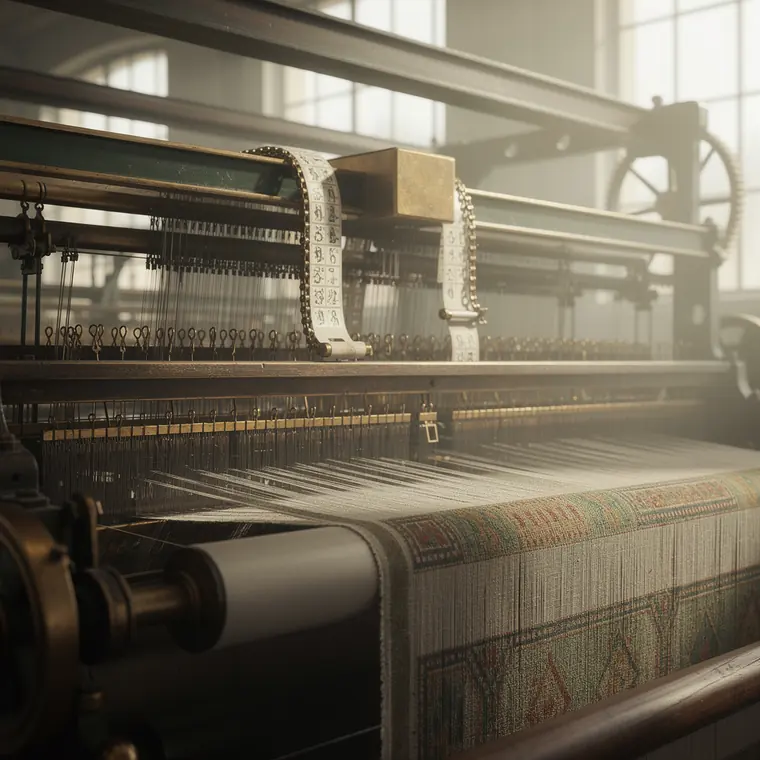
Joseph-Marie Jacquard's loom in a Lyon silk workshop, a chain of laced punched cards passing over the square prism above the harness, hundreds of hooks and lingoes hanging.
- What it was used for
- Figured silks in Lyon. The mechanism controls the warp threads through 600 to 800 hooks and selects them by a programme of punched cards; it replaced the draw boy who sat atop the loom raising and lowering threads by hand. An imperial decree of 15 April 1805 set a bounty of 50 francs for each loom he delivered to be put into service, for six years; another of 27 October 1806 confirmed the annual pension of 3,000 francs granted to Jacquard by the Lyon city council. In Lyon 41 looms were delivered in 1806 and 57 in 1811; by 1834 there were 2,885 in the Croix-Rousse. The Manchester Guardian wrote in 1836 that there were then from 7,000 to 8,000 Jacquard looms in Britain.
- What was new
- The Musée d'histoire de Lyon calls it not an invention properly speaking but the skilful combination of three techniques: Vaucanson's loom, Falcon's punched cards of 1728 and Bouchon's needles of 1725. The practical difference was that one man could work the mechanism instead of several. Vaucanson's machine, which carried the same principle, saw no industrial application at all according to the Musée des Arts et Métiers; in 1803 Jacquard was commissioned to reassemble the dismantled device and get it working. The dates need keeping apart: brevet on 23 December 1801, gold medal on 2 February 1804, bounty decree on 15 April 1805, pension decree on 27 October 1806. Even the dating of Vaucanson's loom varies between 1745, 1746 and 1748.
Connections
Every connection names its kind. “Forerunner” on its own would be a claim.
- Follows fromVaucanson Loom1745The Musée d'histoire de Lyon calls the Jacquard mechanism not an invention proper but the skilful combination of three techniques: Vaucanson's cylinder-controlled loom, Falcon's punched cards of 1728 and Bouchon's needles of 1725.Source: Musée d'histoire de Lyon (Gadagne): Métier équipé d'une mécanique Jacquard
- Works withThe Jacquard Head1804The head is mounted on the loom, on Marsden's account either at right angles to the harness (London system) or parallel to it (Norwich system). Its hooks lift the harness cords that pass through the comber board; their mail eyes carry the warp threads, and lingoes pull them down again. Marsden brings in the head for shedding only; picking and beat-up remain the loom's work.Source: Richard Marsden, Cotton Weaving: Its Development, Principles, and Practice, London 1895, S. 148-150
- Works withThe Card Cutting Bench1820Marsden 1895, p. 190: Stephen Wilson procured the machine in France; on his return he seems to have invented a card-cutting machine and patented the two together, patent no. 4543 of 8 March 1821. The loom needs, as a rule, a separate card for every pick, perforated according to the design (p. 197); those cards are punched beforehand at the cutting bench.Source: Richard Marsden, Cotton Weaving: Its Development, Principles, and Practice, London 1895, S. 190 und 196-197
Further reading
- Musées Gadagne / Musée d'histoire de Lyon, Métier équipé d'une mécanique Jacquard (600-800 Haken, Kombination dreier Techniken, 2.885 Stühle 1834)
- Fondation Napoléon, Marc Allégret: Jacquard, Joseph Marie (1752-1834), mécanicien-tisserand (Dekrete 15.4.1805 und 27.10.1806, 41 und 57 Stühle)
- Musée des Arts et Métiers, Métier à tisser les étoffes façonnées de Vaucanson
- Science and Industry Museum, Programming patterns: the story of the Jacquard loom (Manchester Guardian 1836)
- CILAC, Referat zu François Jarrige: Le martyre de Jacquard ou le mythe de l'inventeur héroïque, Tracés 16 (2009)