The Card Cutting Bench
1820 · Card Punching · Work 565 of 1,871
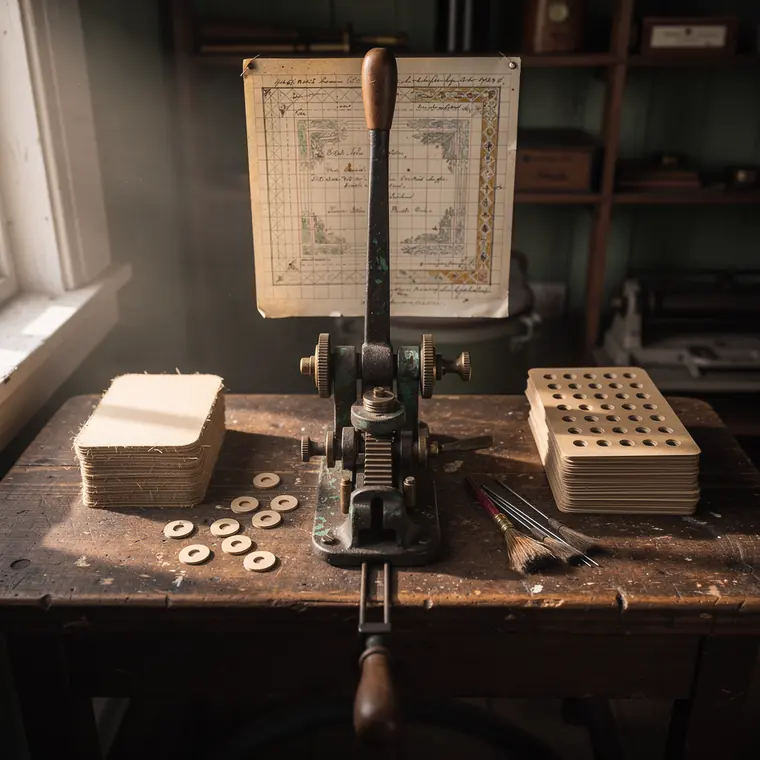
A workshop bench with a hand lever punch clamped to its edge, a stack of blank pasteboard cards on the left and a stack of finished cards pierced with round holes on the right, a sheet of squared design paper pinned to the wall above the punch with a pattern painted onto its grid, a few loose punchings scattered on the bench top, the pasteboard buff against the dark iron of the punch, the bench in a card cutter's workroom lit by daylight from a window at the side, the wall and shelving behind the punch softly blurred.
- What it was used for
- The card cutting bench was the place where the pattern passed from paper into the punched cards. Around 1820 this was done by hand: the blank pasteboard card lay between two perforated steel plates, one man read the hole positions off the design and called them out, a second filled punches into the holes of the upper plate, and the plates went through a roller press which drove the punches through the card. Up to about 300 needles the punches were arranged without any reading-in machine at all (Barlow 1878). Later the card cutter sat at a piano machine, a foot on each treadle, fingers on the keys, eye on a ruler that he screwed down one line for every card he cut.
- What was new
- What was new was a trade. The Jacquard head had removed the drawboy and created the card cutter; as late as 1921 the British occupational classification still carried him as a group of his own, code 396, with titles such as card cutter, piano puncher and card stamper. What that cost is shown by one large pattern: for the "Crimean Hero Table-cloth" made at Dunfermline, Barlow reports 50,000 cards cut, with design and execution taking about eight months and costing nearly 600 pounds. An early machine meant to read the design and punch the cards was patented by Stephen Wilson in 1821; the piano machines only prevailed decades later. Bell writes in 1895 that a good cutter cuts 100 to 150 cards an hour, "but this is laborious for constant work".
What the sources leave open: The date 1820 fits hand punching between two steel plates, not the piano machine: as late as 1878 Barlow names the reading-in machine after Wilson's patent as the plan most generally used in the silk manufacture. No wage figures for card cutters were found in any source.
Connections
Every connection names its kind. “Forerunner” on its own would be a claim.
- Works withThe Squared Design Paper1830The cards were cut from the drawn design. The Science Museum holds a "Machine for cutting Jacquard cards from the original design" by DeVoge and Co.; the Mingei project describes the path from point paper through the punched card to the cloth.Source: Science Museum Group: Machine for cutting Jacquard cards from the original design · Mingei Project: The story of Jacquard weaving
Further reading
- T. F. Bell, Jacquard Weaving and Designing (London 1895), Kap. V 'Card-Cutting and Lacing', S. 139-154
- Alfred Barlow, The History and Principles of Weaving (London 1878), S. 147, 319, 321-323
- E. A. Posselt, The Jacquard Machine Analyzed and Explained (Philadelphia 1887), S. 85-97
- A Dictionary of Occupational Terms, Census of Population 1921, Code 396: Jacquard Punchers and Card Cutters
- Machine for cutting Jacquard cards (DeVoge and Co.), Science Museum Group Collection, Object 1912-316