The Works Village
1880 · Company Housing Estate · Work 382 of 1,871
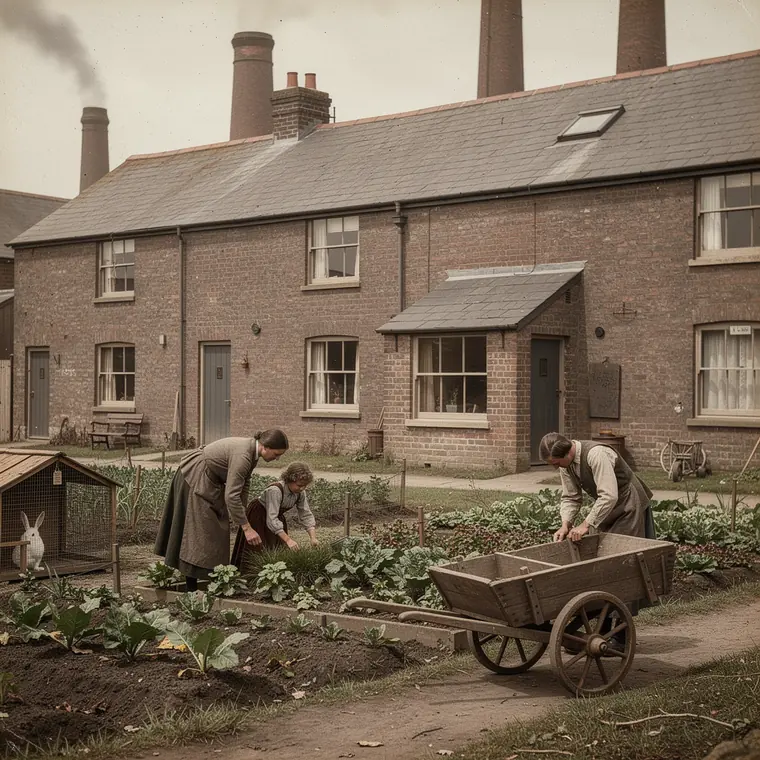
A family tending a vegetable plot behind a row of plain brick company-built cottages of two storeys with small windows and plain pitched roofs, tall brick works chimneys and mill roofs rising past the gable ends and smoking, a rabbit hutch and a heavy wooden barrow with one iron-shod wooden wheel standing by the fence, the man in waistcoat and cloth cap, the woman in a long skirt and apron.
- What it was used for
- Workers' housing built by the employer next to the works. Titus Salt put up his worsted mill at Shipley and a whole village with it: construction of the mill began in 1851, it opened in 1853. The UNESCO nomination dossier states that by 1871 Saltaire housed 4,300 people on twenty-five acres; the Saltaire Collection gives around 3000 workers in the mill, Bradford Council over 800 houses, and forty-five almshouses were completed in 1868. At Essen, Krupp had already finished 2,358 company dwellings by 1874. The village supplied housing and supervision in one piece: for Port Sunlight the Royal Geographical Society writes that if you lost your job at the factory you also lost your family home, and the same account lists among William Lever's objections sloth, drinking, gambling and simply failing to take a full part in the village's extra-curricular activities. According to the Port Sunlight Village Trust, tied tenancies there ended only in 1999.
- What was new
- The form was not new. The Gregs' settlement at Styal was, according to the National Trust, already a village of 300 tenants with a school and a shop by 1840 — and with two families to each cottage, the second living in the cellar. What was new was the scale in a single act of planning: housing, church, school, almshouses, institute, park and bathhouse laid out beside an integrated factory. Who came first cannot be settled, and the sequence carries nothing anyway: Saltaire from 1851, Akroydon from 1859, Bournville from 1887, Port Sunlight from 1888 — and Krupp at Essen with 2,358 dwellings by 1874, ahead of the two later English model villages and larger in number than Saltaire. Steffen Krämer's survey of the German company colonies explicitly names the English company villages as the models for the Krupp colonies and compares Saltaire with the Essen colony of Cronenberg (1872–1874); Bournville he cites for Gmindersdorf in Reutlingen.
Connections
Every connection names its kind. “Forerunner” on its own would be a claim.
- Parallel toChocolaterie Menier Noisiel1872The chocolate works at Noisiel got its company village too: the cité ouvrière Menier was founded in 1874, over three hundred houses along three parallel streets, not finished until the 1910s. The schools were built first; in 1884 refectories followed, where workers who did not live in Noisiel ate their midday meal under shelter. Mill and village form one ensemble.Source: Ville de Noisiel, Parcours du patrimoine 2023 (PDF), Nr. 8 La cité Menier, Nr. 11 Les anciennes écoles, Nr. 14 Les anciens réfectoires · Cité de l'architecture et du patrimoine, Itinérances: La chocolaterie Menier (PDF)
Further reading
- UNESCO, Nomination Dossier Saltaire (Nr. 1028)
- Saltaire Collection, Heritage Trail (PDF)
- Bradford Council, Saltaire World Heritage Site: information and history
- Royal Geographical Society, Discovering Britain: Port Sunlight walk
- Port Sunlight Village Trust, Conservation Management Plan 2018-2028
- Steffen Krämer, Deutsche Unternehmer und ihre Arbeiterkolonien im 19. und frühen 20. Jahrhundert (kunstgeschichte-ejournal.net)
- National Trust, Quarry Bank: the buildings