The Wash House
1885 · Wash House · Work 383 of 1,871
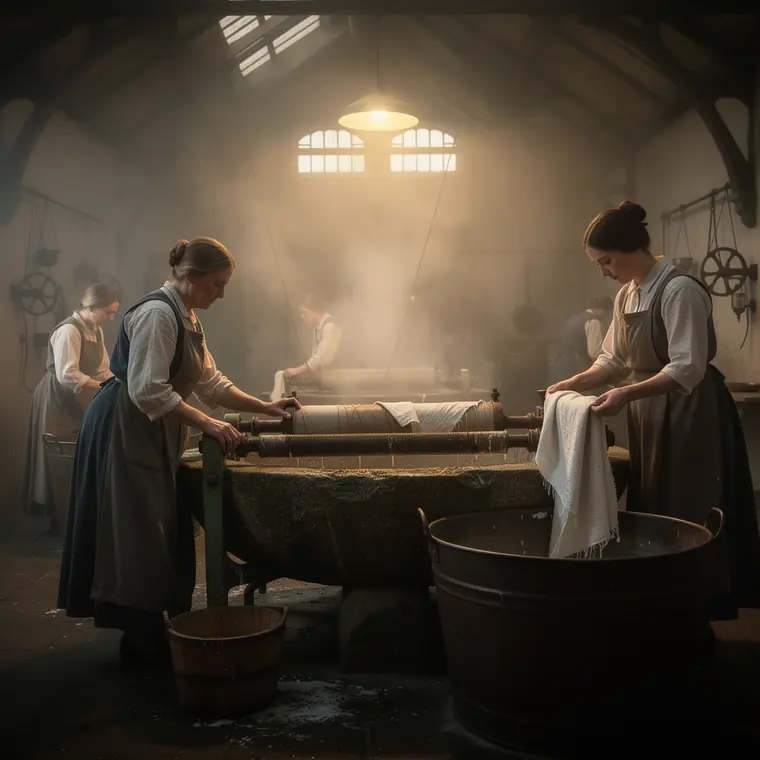
Women at stone troughs in a communal wash house, one turning a mangle while another lifts linen from a copper with a wooden dolly, steam filling the vaulted room.
- What it was used for
- Public baths and wash-house for working families. William Quekett, incumbent of St George's-in-the-East, wrote in his 1888 memoir "My Sayings and Doings" about the scheme he pushed in 1846: a poor woman's washing at home occupies parts of three days, whereas in such an establishment it could all be done in half a day. According to the circular of the Goulstone Square committee in Whitechapel, which Quekett reprints, payment was to be by the clock, not by the load — one penny for an hour at the tubs and two further hours in the drying closet and ironing room. Quekett cites Liverpool, where the Corporation set up 18 baths and 28 washtubs in 1842 on an outlay of £2,300. At Stockton-on-Tees, opened 9 June 1859, the town counted 9,390 bathers and 5,120 washers in 1860, and 11,882 and 9,039 by 1865. Glasgow's Greenhead establishment of 1878 had accommodation for forty washers.
- What was new
- Washing in company was not new: Glasgow Life dates a public wash-house on the Green to 1732, a second survey to 1730 — the year is disputed. What was new were steam, the drying closet and the timetable, that is, the compression of the washing day. Carefully put, Liverpool 1842 counts as the first warm freshwater wash-house in Britain; Quekett himself calls it the first cheap baths and wash-houses for the poor, not the first of any kind. The barb is in the Whitechapel committee's circular, which Quekett reprints beside his own 1846 appeal: the woman had to find her own soap, and there were to be no mangles, expressly because many industrious persons made their living by keeping mangles. The device was left out so as not to take away their livelihood. And the sixpenny bath was the same tub as the penny bath; only the fitting up of the room differed.
Connections
Every connection names its kind. “Forerunner” on its own would be a claim.
- Works withThe Works Village1880The baths and wash house were one of the village buildings: Salt built them at Saltaire in 1863 at a cost of £7,000, with 24 baths, twelve each for men and women, and a Turkish bath. The Builder had listed baths and washhouses among the works ordered for the village in 1852.Source: Saltaire Collection / Saltaire Stories, Heritage Trail Saltaire (PDF), Nr. 19 Bath and Wash houses · UNESCO, Nomination Dossier Saltaire (Nr. 1028), Zitat aus The Builder, 1852
Further reading
- William Quekett, My Sayings and Doings (Kegan Paul & Trench 1888), S. 174ff., Volltextauszug bei St George-in-the-East
- Stockton-on-Tees Borough Council, Heritage: Stockton's Public Baths and Wash-house
- Glasgow Life / Mitchell Library, Ask the Archivist: baths and wash-houses
- Baths and Wash-houses Archive, Timeline
- Les Back, Bathed in feeling: water cultures and city life, in: Living with Water (MUP 2023), Volltext Universität Glasgow
- UK Parliament, Living Heritage: Baths and Washhouses Act