The Canteen Table
1890 · Works Canteen · Work 384 of 1,871
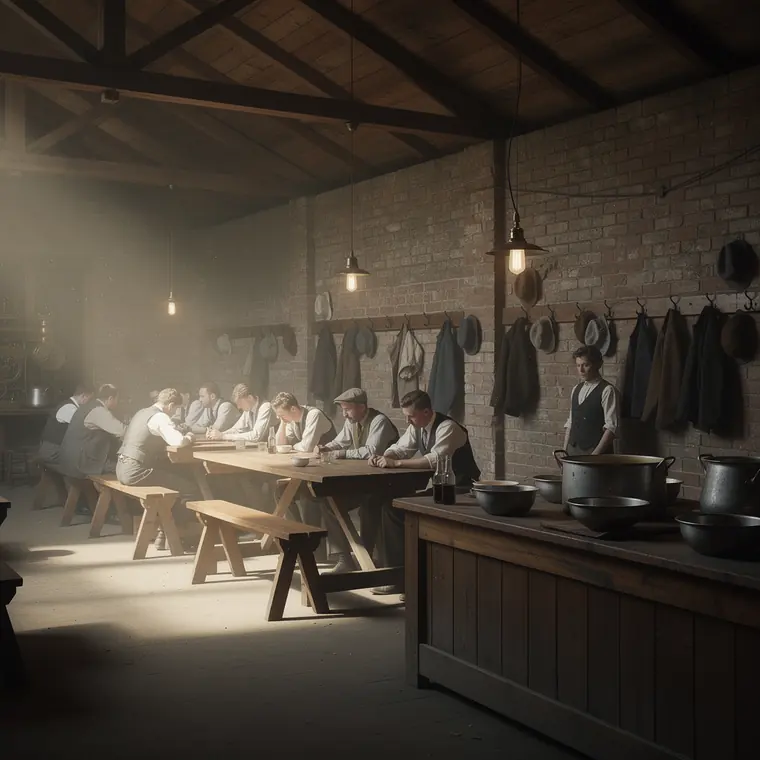
Workers seated along trestle tables in a works canteen: a plain hall with brick walls and a timber roof, tin bowls and a large iron soup pot on the wooden serving counter, caps and jackets hung on pegs along the wall, the men in waistcoats and shirtsleeves, the hall lit by daylight through the windows and gas lamps.
- What it was used for
- The works dining room. Budgett Meakin described the state of things around the turn of the century in "Model Factories and Villages" (1905) — fifteen years after this work's date, which has to be read along with it. At Bournville, tables for 2,000 of Cadbury's women workers were in regular use; roast and two vegetables cost 4d, soup and bread 1d, tea a halfpenny. The women's dining hall at Port Sunlight, dated by Historic England as Hulme Hall, 1901, architects William and Segar Owen, cost £18,000 and seated 1,500, of which Meakin says only about half were as a rule occupied; the men went on bringing food from home in cans and had it warmed. In the two rooms at the Gateshead railway works, seating 1,100, Meakin reports a ten-inch division running down the centre of each table, so that no one could see what the man opposite had brought.
- What was new
- What was new was not the hot meal but the accounting. Tickets had to be bought in advance and at Bournville were dropped into a box containing violet dye that made a second use impossible; at Villeroy & Boch attendances were marked on a card and the amount deducted from the week's wages; at Colman's in Norwich hot meals had to be ordered before 9 a.m. This is bookkeeping introduced into the dinner hour. One should not speak of the first works canteen: Meakin himself places Colman only among the pioneer firms and adds that they have since been out-distanced by others. Even the word is missing — "canteen" does not occur in his 1905 survey, which says dining-room, dining-hall, mess-room. The purpose was stated plainly in the National Cash Register Company's arithmetic: a loss of three halfpence a head on each meal, against nearly twice as much gained from better work during the afternoon.
Connections
Every connection names its kind. “Forerunner” on its own would be a claim.
- Works withThe Works Village1880The dining hall belonged to the village: at Saltaire it was in 1854 the first building completed after the mill and served 600 breakfasts and 700 dinners a day, cheaply, to the workers who had to travel in. In 1852 The Builder named a large dining hall and kitchens among the works ordered for the village.Source: Saltaire Collection / Saltaire Stories, Heritage Trail Saltaire (PDF), Nr. 2 Dining Hall · UNESCO, Nomination Dossier Saltaire (Nr. 1028), S. 39 The Dining Room (1854) und Zitat aus The Builder, 1852
Further reading
- Budgett Meakin, Model Factories and Villages: Ideal Conditions of Labour and Housing (London 1905), Kap. V Meals, Volltext
- Historic England, Hulme Hall, Port Sunlight, List Entry 1183574
- Historic England, Gladstone Hall, Port Sunlight, List Entry 1300139 (Assembly Hall, 1891 — nicht als Speisesaal gelistet)