Pascaline
1642 · Pascal's Wheel Adder · Work 402 of 1,871
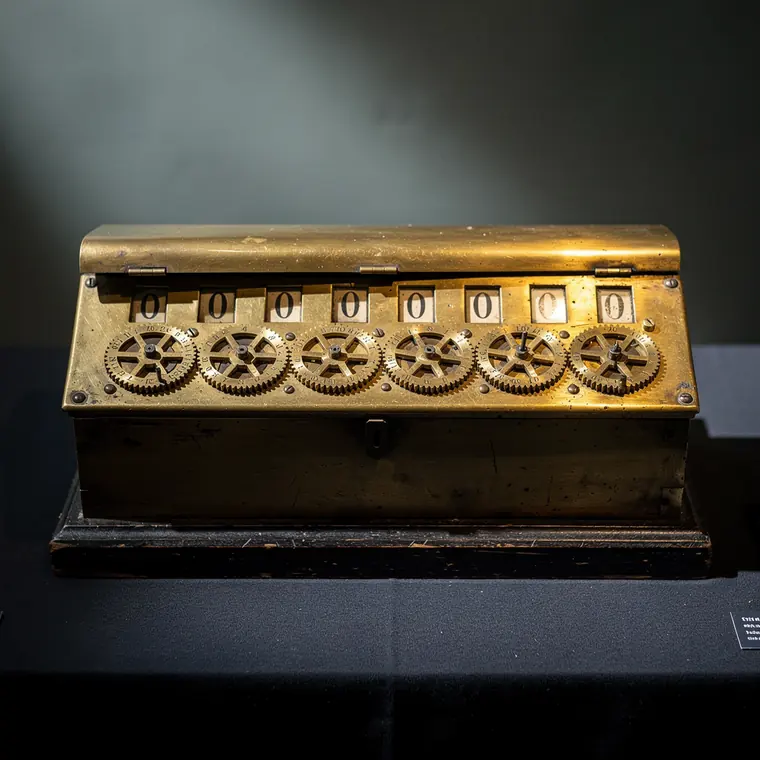
A low brass box the length of a forearm, its top face pierced by a row of spoked setting dials across the full width, exactly eight spoked setting dials, each dial a flat toothed wheel with a small stylus notch between the spokes, above them a strip of small square windows, the numeral windows show exactly 0 0 0 0 0 0 0 0, one digit per window, a hinged brass shutter running the full length above the windows, every other surface plain polished brass, the box set on a plain ebonised wooden base, standing on a dark baize-covered table before a deep neutral background, a single raking light from the left running along the row of dials.
- What it was used for
- Blaise Pascal built the machine for the work of his father Étienne, who according to the Bibliothèques Clermont Auvergne Métropole was "commissaire député par sa Majesté ... en la Haute Normandie, pour l'impôt et la levée des tailles" at Rouen. There were variants for the non-decimal currency: one livre of twenty sols, one sol of twelve deniers. It only added; subtraction was done through complements. The number made is disputed: the Computer History Museum gives about fifty machines built, of which Pascal sold only some fifteen, while Clermont speaks of about fifty prototypes and twenty finished examples in the end.
- What was new
- What was new was not the mechanism but that the machine became a product: Schickard's two machines of about 1623 are lost, Pascal's was sold in small numbers and protected from 22 May 1649 by a royal privilege granted by Louis XIV (date of grant). The privilege did not help. According to Clermont, unauthorised copies were made; Pascal stopped manufacturing and instead authenticated individual machines with his signature. The price did the rest: the HNF gives 100 to 500 livres, while a clock then cost 75 to 125 livres. Eight historical Pascal machines survive according to the HNF; a ninth was assembled from older parts in the eighteenth century.
Connections
Every connection names its kind. “Forerunner” on its own would be a claim.
- Parallel toSchickard's Calculating Clock1623Schickard described his calculating clock to Kepler in 1623; the half-built machine burned in 1624. Sketches survived in the papers of Schickard and Kepler and were not rediscovered until 1935. The sources name no link to Pascal's machine of 1642: two geared calculating mechanisms, arrived at independently.Source: Wilhelm Schickard - Biography, MacTutor History of Mathematics, University of St Andrews