Leibniz Stepped Reckoner
1694 · Stepped Drum · Work 403 of 1,871
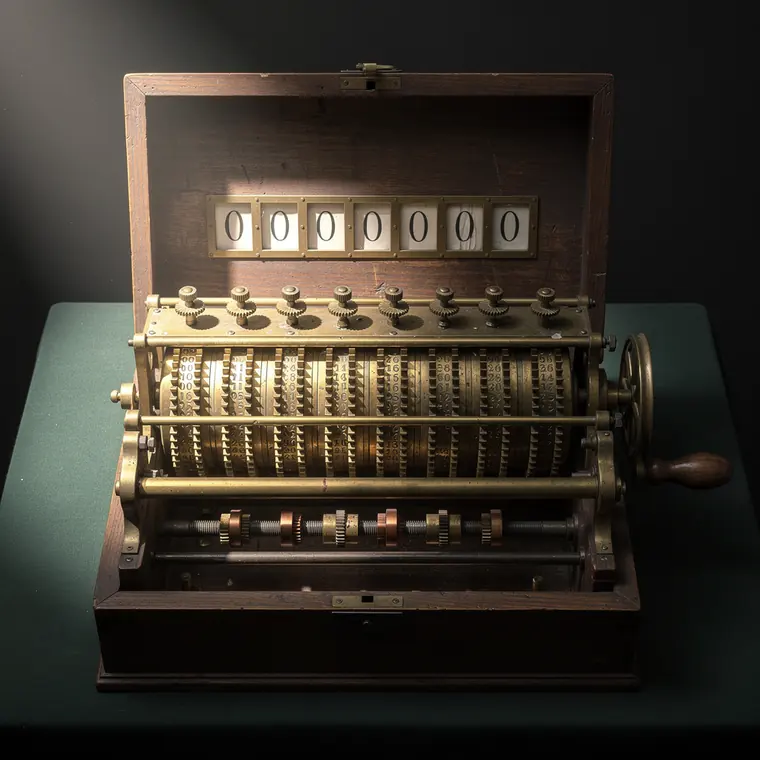
A long calculating machine in a fitted wooden case, a fixed rear section carrying a row of small numeral windows and a movable front carriage that slides along it on rails, a large crank handle with a turned wooden grip at the right end, the body opened to show eight cylinders lying parallel in a row, each cylinder ribbed with teeth of increasing length like a staircase wound round a drum, a row of setting dials along the carriage, the numeral windows show exactly 0 0 0 0 0 0 0 0, one digit per window, every other surface plain brass and dark oak, standing on a dark baize-covered table before a deep neutral background, a single raking light from the left raking across the stepped drums.
- What it was used for
- The only surviving example, not a working instrument. On 1 February 1673 — 22 January in England under the Julian calendar — Leibniz showed a model to the Royal Society; the surviving machine is a later and different object and weighs fourteen kilograms according to the city of Hanover. Its dating is disputed: Hanover calls it the fourth "machina arithmetica", developed around 1690, while the Deutsches Museum dates the original to "about 1700" and records an object range of "c. 1670 - 1716"; none of the sources cited supports the year 1694. No actual use in calculation is documented in them.
- What was new
- It could do what the Pascaline could not: multiply without the operator setting every partial step by hand. The Deutsches Museum records a stepped drum for each place of the eight-digit setting register and a sixteen-digit result register; according to TU Dresden the number set can be added at any position, which makes multiplication and division possible by repetition. Subtraction was done by reversing the crank. The carry was the weakness: the Deutsches Museum writes that owing to a design fault the tens carry propagates at most three places, which explains Leibniz's difficulties with this machine. TU Dresden gives a different cause for the jamming tens carry: N. Joachim Lehmann is said to have found an error of reasoning committed during the restoration work of 1894. Design fault or restoration fault — that is open. 1894 is also the year the machine reappeared in the loft of the university church at Göttingen.
Connections
Every connection names its kind. “Forerunner” on its own would be a claim.
- Parallel toSchickard's Calculating Clock1623Schickard wrote to Kepler in 1623 that his machine "adds, subtracts, multiplies and divides". The TU Dresden collection describes Leibniz's calculating machine as a stepped-drum four-species machine, built for the same four operations. Schickard's sketches were not rediscovered until 1935; the sources name no link to Leibniz.Source: Wilhelm Schickard - Biography, MacTutor History of Mathematics, University of St Andrews · TU Dresden, Fakultät Mathematik, Sammlung historischer Rechenmaschinen: Leibniz-Rechenmaschine