Burkhardt Arithmometer
1878 · Stepped Drum · Work 409 of 1,871
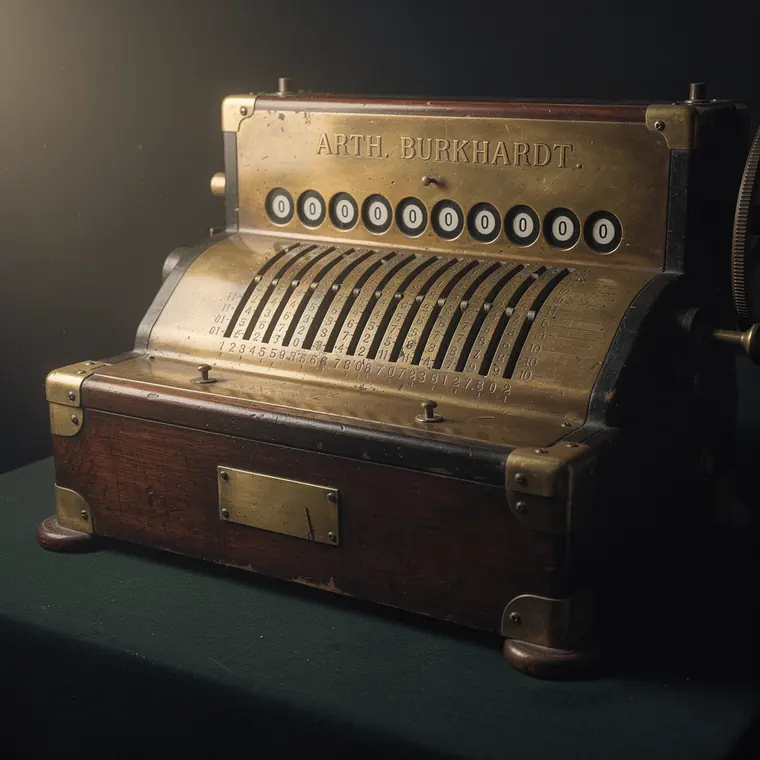
A stepped-drum calculating machine in a heavy wooden case with brass corner protectors, sliding setting levers in parallel slots across the brass top plate, a small index scale of the digits 0 to 9 engraved beside each slot, two rows of small round result windows, each window showing the single digit 0, a plain rectangular brass maker's plate screwed to the front edge, a crank at the right end, every other surface plain polished brass and dark varnished wood, a cast maker's line on the lacquered top plate reading "Arth. Burkhardt", standing on a dark baize-covered table before a deep neutral background, a single raking light from the left catching the brass corners of the case.
- What it was used for
- In Glashütte in Saxony, Arthur Burkhardt built stepped-drum machines on the pattern of the French Thomas arithmomètre. The Arithmeum names the advantage plainly: it lay in the fact that for repair and maintenance the machine no longer had to be sent to Paris but only to Saxony. In 1892 three models were available: six-digit at 375 marks, eight-digit at 475, ten-digit at 675. According to the Rechnerlexikon as quoted on glashuetteuhren.de, just 500 machines had been completed by 1892; there are also serial numbers: number 248 was sold on 15 October 1887 according to glashuetteuhren.de, number 627 left the works in 1895, and the Smithsonian dates number N1197 to about 1900. According to rechnerlexikon.de, Glashütte's watch industry and its trained craftsmen had prepared the ground.
- What was new
- What was new was the manufacture, not the mechanism. Johnston records that arithmometer clones were first made in Germany by Burkhardt and only slightly later in Britain; where Thomas in Paris sold barely a hundred machines a year on Sebert's figures, a German series production started here. The year is more a company year than a machine year (Arithmeum: built from 1878): according to rechnerlexikon.de Burkhardt arrived in Glashütte in October 1878, called there by Curt Dietzschold, and production of Model A began only in 1880 according to glashuetteuhren.de. Two reversals. On 1 September 1895 three former Burkhardt men — Eduard Zeibig, Eugen Straßberger and J. Schumann — founded the rival firm Saxonia in the same town; in 1920 it was merged with Burkhardt, and in 1929 the company was dissolved. And the advantage of not having to send machines to Paris dissolved: according to the Smithsonian, this German version of the machine was being sold in Paris by the early twentieth century.
Connections
Every connection names its kind. “Forerunner” on its own would be a claim.
- Follows fromThomas Arithmomètre1851For the machine he built in Glashütte from 1878, Arthur Burkhardt confined himself to a slightly altered copy of Thomas's arithmomètre. It was the first German stepped-drum machine made in series.Source: Das Arithmometer von Arthur Burkhardt (Arithmeum, Universität Bonn) · Stephen Johnston, Making the arithmometer count (History of Science Museum, University of Oxford)
Further reading
- Arithmeum, Universität Bonn: Das Arithmometer von Arthur Burkhardt - der Beginn einer deutschen Rechenmaschinenproduktion
- Smithsonian National Museum of American History: Burkhardt Arithmometer (Nr. N1197)
- Rechnerlexikon: Rechenmaschinenfertigung in Glashütte
- glashuetteuhren.de: I. Deutsche Rechenmaschinenfabrik Arthur Burkhardt 1878-1929
- Stephen Johnston: Making the arithmometer count