Layton's Arithmometer
1883 · Stepped Drum · Work 410 of 1,871
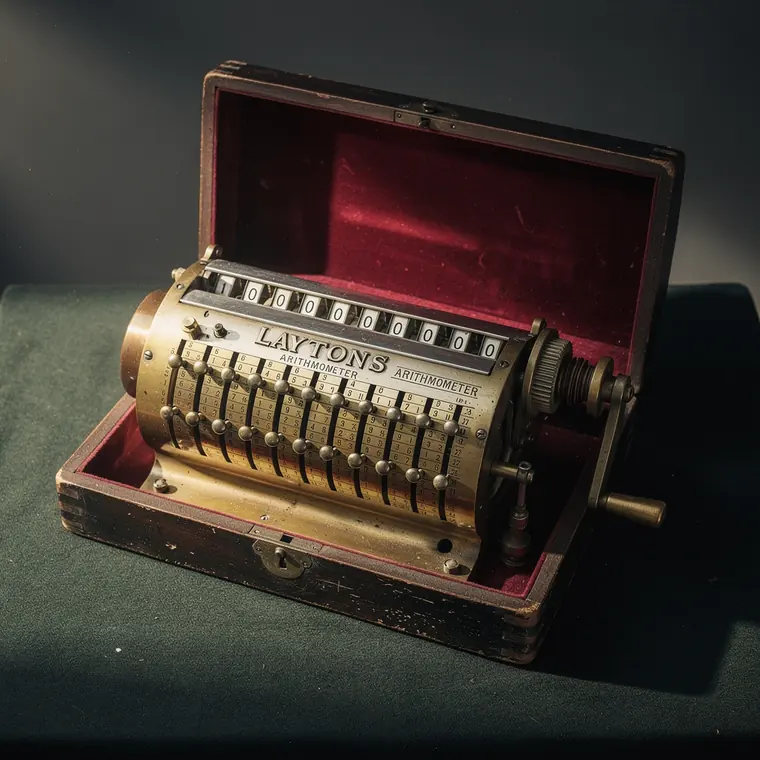
An English stepped-drum calculating machine, its brass top plate silvered to a soft matt sheen and engraved with plain index scales beside each setting slot, setting levers with round finger pieces in a row across the plate, a row of small numeral windows above, each window showing the single digit 0, a hinged crank folded flat against the right side of the case, the whole machine resting in a fitted box lined with deep red velvet, every other surface plain silvered brass, an engraved plate beside the setting levers reading "Laytons Arithmometer", standing on a dark baize-covered table before a deep neutral background, a single raking light from the left raking across the silvered plate and the velvet.
- What it was used for
- C. & E. Layton of London — Charles and Edwin Layton, according to the Computer History Museum — were, according to the Smithsonian, London publishers of works on insurance, annuities and mathematics, who also manufactured the machine. What they sold was Samuel Tate's construction: "Tate's machine was manufactured by the publishers C. & E. Layton of London, who made various improvements to it", writes the Smithsonian, and of example number 1431 of about 1905: "Layton sold arithmometers particularly to insurance companies." That piece is a gift of the Colonial Life Insurance Company of America. The Science Museum records "Layton's improved arithmometer no.1624", inv. 1962-211, capacity "7 x 7 = 12 figures", London, 1900-1920, received through the Commonwealth Institute. Distribution reached New York: below the operating handle the machine is marked "C.A. BAYNON AGENT NEW YORK".
- What was new
- Nothing of Layton's own is documented here, and that is the entry. Which "improvements" Layton made is not documented, nor is a price or a quantity — the serial numbers demonstrably reach 1624 and 2733, but that is a lower bound drawn from numbers, not a production figure. Nor is any event documented for the year 1883; museum datings of the surviving pieces run from about 1887 to 1920. What is documented is what stands on the machines: number 140 of about 1895 reads "TATE'S PATENT ARITHMOMETER C. & E. LAYTON LONDON", number 1431 of about 1905 only "C. & E. LAYTONS ARITHMOMETER LONDON". Tate's name does not disappear altogether, though: the Science Museum lists the higher number 2733 (1900-1920) as "Tate's patent arithmometer". And for piece 1624 in the Science Museum the maker field is blank, although the object title carries Layton's name.
Connections
Every connection names its kind. “Forerunner” on its own would be a claim.
- Follows fromThomas Arithmomètre1851The London publishers C. & E. Layton made the machine to Tate's patent, filed as an improvement on the arithmometer invented by Charles Xavier Thomas, and added changes of their own. A stepped drum sits beneath each of the eight setting levers.Source: Layton's Arithmometer (National Museum of American History, Smithsonian Institution)
Further reading
- Smithsonian National Museum of American History: Layton's Arithmometer (Nr. 1431, ca. 1905)
- Smithsonian NMAH: Stepped Drum Calculating Machines (Objektgruppe)
- Science Museum Group Collection: Layton's improved arithmometer no.1624 (Inv. 1962-211)
- Computer History Museum: Tate's Arithmometer, Kat. 102633500 (Hersteller Charles und Edwin Layton)