Tate's Arithmometer
1885 · Stepped Drum · Work 411 of 1,871
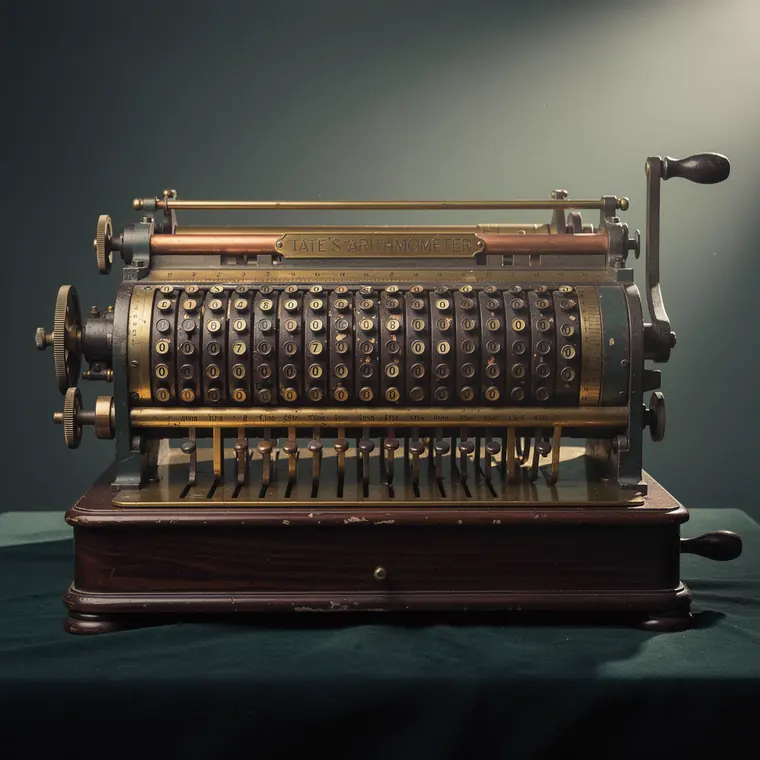
A wide stepped-drum calculating machine with an unusually long carriage running the full width of the picture, a double row of small round numeral windows along the carriage, each window showing the single digit 0, thumb wheels for clearing at both ends of the carriage, a row of sliding setting levers on the brass top plate below, a hand crank standing upright at the right, the machine in a long dark wooden case with brass fittings, every other surface plain polished brass, an engraved plate on the brass top reading "Tate's Arithmometer", standing on a dark baize-covered table before a deep neutral background, a single raking light from the left raking along the double row of windows.
- What it was used for
- Samuel Tate, according to the Smithsonian an engineer of Clerkenwell Close in Middlesex County, applied in 1881 for a British patent on an improvement to the Thomas arithmomètre and received it in 1884: S. Tate, "Improvements in Calculating Machines or Arithmometers", British Patent 1884 No. 65. 1885 is the year of the International Inventions Exhibition in London, that is an exhibition year and not a year of invention. One piece came from a British government department: the Science Museum records "Tate's patent arithmometer no. 2733", inv. 1961-44, capacity "8 x 9 x 16 figures", with the credit line Board of Trade. The Smithsonian's number 140 has eight setting levers, a changeover lever "ADD MULT / SUB DIV", and a bell: "When the entry in the result register would become negative, a bell rings."
- What was new
- There is a formally documented act of invention — and no description of what it achieved. The patent GB 65/1884 can be cited, but its content is not documented; the specialist literature Johnston points to for the English machines of Tate and Edmondson is the printed Science Museum catalogue by Baxandall, revised by Jane Pugh, and it was not consulted. The Smithsonian characterises Tate's intention as simpler, faster, sturdier and more accurate, but names no component for it. The only functionally distinct feature nameable on the object is the bell that rings when the result register would go negative — whether it belongs to the patent is not documented, and the Smithsonian describes such a bell on the Burkhardt arithmometer N1197 of about 1900 as well. The barb: the machine was built and further improved by C. & E. Layton, according to the Smithsonian at least until the First World War, and some later pieces carry only Layton's name.
Connections
Every connection names its kind. “Forerunner” on its own would be a claim.
- Follows fromThomas Arithmomètre1851In 1881 the English engineer Samuel Tate applied for a British patent on an improvement to the arithmometer invented by Charles Xavier Thomas. The Smithsonian's machine is built on Tate's 1884 patent, British Patent 1884 No. 65.Source: Tate's Arithmometer (National Museum of American History, Smithsonian Institution)
Further reading
- Smithsonian National Museum of American History: Tate's Arithmometer (Nr. 140, ca. 1895; mit Patentreferenz GB 1884 No. 65)
- Smithsonian National Museum of American History: Tate's Arithmometer (ca. 1900)
- Science Museum Group Collection: Tate's patent arithmometer no. 2733 (Inv. 1961-44, Board of Trade)
- University of Toronto Scientific Instruments Collection: Tate Arithmometer
- Stephen Johnston: Making the arithmometer count (Fußnote zu Tate und Edmondson, Verweis auf Baxandall/Pugh)