Saxonia
1895 · Stepped Drum · Work 412 of 1,871
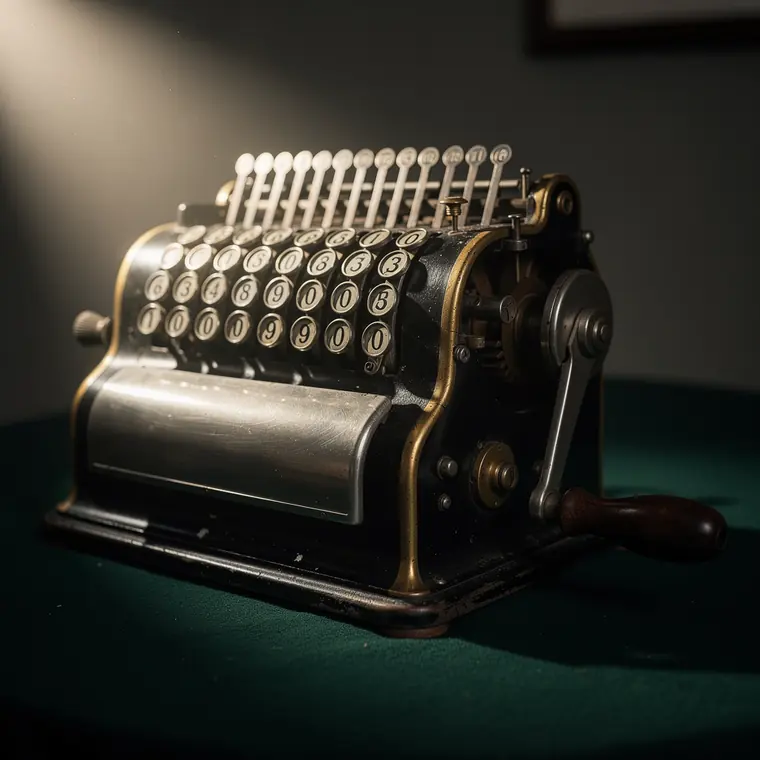
A compact German stepped-drum calculating machine, black enamelled body with fine gold-lined edges, nickel-plated setting slides in parallel slots across the top, small round numeral windows in two staggered rows, each window showing the single digit 0, a crank with a turned wooden grip at the right, a plain nickel plate on the front edge, every other surface plain black enamel and nickel, standing on a dark baize-covered table before a deep neutral background, a single raking light from the left catching the gold lining of the edges.
- What it was used for
- A stepped-drum four-function machine from Glashütte in Saxony, hand-cranked, set by sliders. The Arithmeum's Saxonia 1 (no. 1060) works to 6 x 7 x 12 places, weighs 7.3 kg and comes from the production run of 1895 to 1901 (made c. 1900); the carriage had to be lifted both to set and to clear, and the revolution counter had no tens carry. It was sold abroad as well: in the United States the dealer Reuter sold Saxonia machines as "Reuter's Multiplying and Dividing Machine". The workshop was founded on 1 September 1895 by Eduard Zeibig, Eugen Straßberger and J. Schumann, all three previously with A. Burkhardt in the same town, whom they thereby set up against. Rechnerlexikon gives roughly 12,000 machines between 1895 and 1914, from 20 to 25 workers and 40 machine tools. In 1920 Saxonia and Burkhardt had to merge; in 1929 came bankruptcy.
- What was new
- Not the principle. The stepped drum had been in series production since Thomas's Arithmomètre, and from 1878 Burkhardt in Glashütte developed his own on the model of the Thomas machine. What was new lay in the detail: Rechnerlexikon credits Saxonia with a rotating-lever setting that allowed a dust-tight enclosure, and from 1901 instant clearing by pull lever instead of wheel clearing - which is what turned the Saxonia 1 into the Saxonia 2. The full keyboard to which Saxonia confined itself after 1920 while Burkhardt did without it was only patented in 1919 (DRP 338902), almost a quarter-century after the founding and a year before the merger with Burkhardt.
Connections
Every connection names its kind. “Forerunner” on its own would be a claim.
- Follows fromBurkhardt Arithmometer1878The founders of the Saxonia works in Glashütte - Zeibig, Strassberger and Schumann, 1 September 1895 - had learned calculating-machine building at A. Burkhardt's. Per the Arithmeum the first machines did not differ from Burkhardt's model; the switching principle and the carry mechanism were essentially his.Source: Arithmeum, Sammlung Rechnen einst: Saxonia 1