TIM
1907 · Stepped Drum · Work 414 of 1,871
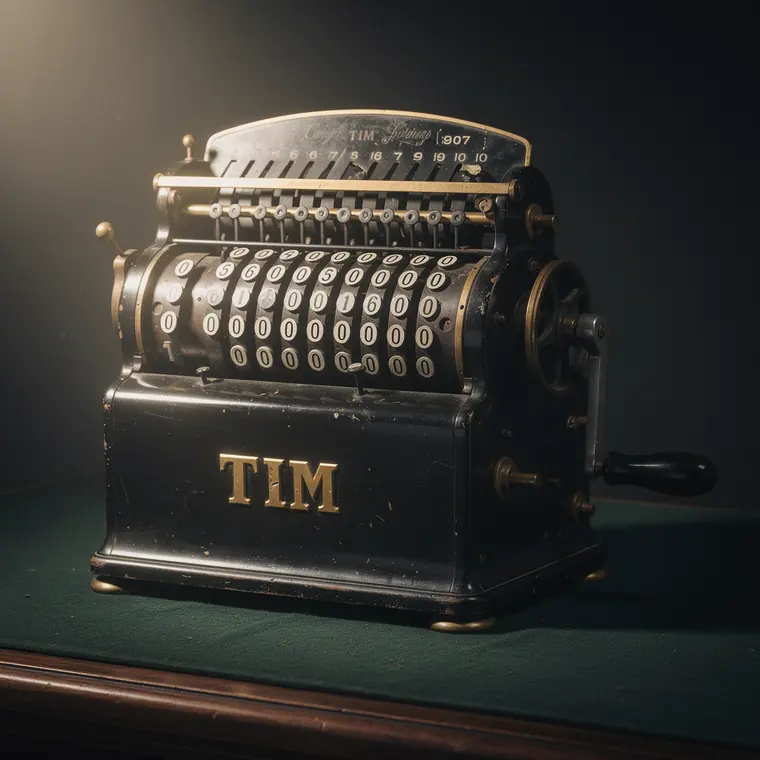
A stepped-drum calculating machine in a black enamelled case, gilt lettering on the front of the case reading "Tim", sliding setting levers in a curved slot plate across the top, a wide carriage with two rows of white numerals on black drums, every drum showing the single digit 0, a crank with a black wooden grip at the right, every other surface plain black enamel and polished brass, standing on a dark baize-covered table before a deep neutral background, a single raking light from the left catching the gilt letters and the white numerals.
- What it was used for
- A stepped-drum four-function machine by Ludwig Spitz & Co. GmbH of Berlin-Tempelhof, sold under the trademark "TIM Time is Money". The Smithsonian describes eight zinc-alloy stepped drums, a result register of 16 windows and a revolution counter of nine. It was used in large administrations: the Museumsstiftung Post und Telekommunikation holds a full-keyboard TIM which it catalogues under the keywords Deutsche Reichspost and Postscheckamt (postal cheque office) - 450 mm wide, 14.08 kg. London's Science Museum has a TIM that came from the Prudential Assurance Company, that is from an insurance office.
- What was new
- Not the stepped drum, which was over two hundred years old. What the TIM could do was carry a 16-place result register in an office machine of which examples survive from postal and insurance ownership. The Smithsonian states that the TIM was introduced in 1907 and first sold in a cast-iron housing in 1909; its own example was taken from a wooden case. Whether Spitz was ahead of the Glashütte works with a full-keyboard stepped-drum machine is not stated by any source checked here; the Museumsstiftung dates its own full-keyboard TIM only to roughly the 1920s to 1940.
Connections
Every connection names its kind. “Forerunner” on its own would be a claim.
- Follows fromThomas Arithmomètre1851The Heinz Nixdorf MuseumsForum describes the TIM, built by L. Spitz & Co. of Berlin from 1907, as a stepped-drum machine "of the kind of the machine of Thomas de Colmar". Versions with two counters were sold by the firm as the "Unitas".Source: Heinz Nixdorf MuseumsForum, museum-digital: TIM (Time Is Money)