Marchant
1911 · Pinwheel · Work 418 of 1,871
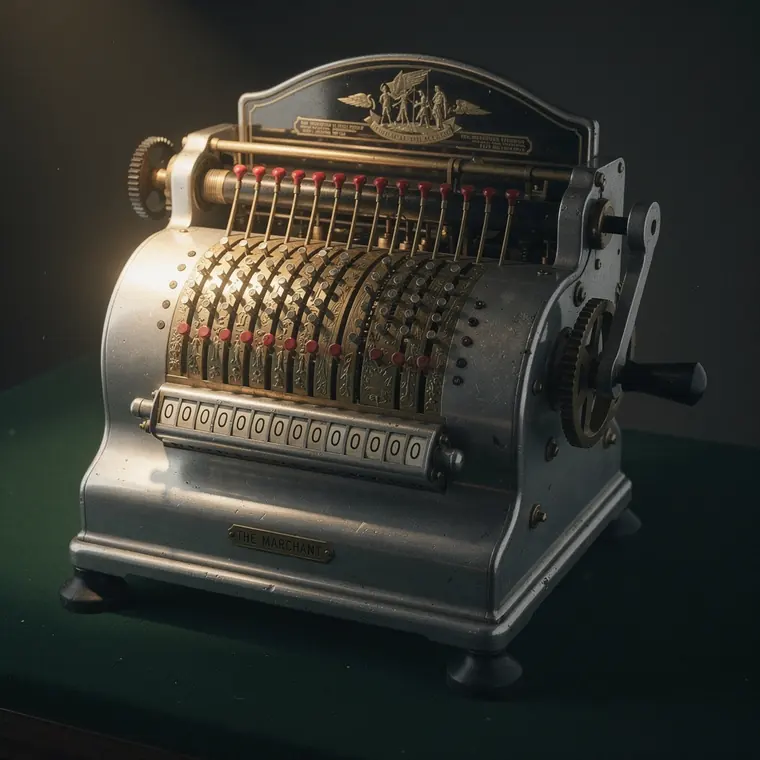
An American pinwheel calculating machine, a nickel-plated body with a curved rear apron, a fan of setting levers across the drum with red-tipped indicators, two counting registers of different lengths across the front carriage, each register a row of small windows showing the single digit 0, a crank on the right, four rubber feet on a slate-coloured cast base, every other surface plain bright nickel, a maker's plate on the front reading "The Marchant", standing on a dark baize-covered table before a deep neutral background, a single raking light from the left sliding across the curved nickel apron.
- What it was used for
- A pinwheel four-function machine from Oakland, California. The Smithsonian records that Rodney H. Marchant filed a patent on 23 February 1911 and at first built machines with his brother under the name Marchant Brothers; in 1913 the Marchant Calculating Machine Company took over the assets and sold chiefly in the western United States. The Model A Standard has nine setting levers, a carriage of 13 windows, a steel housing and a wooden base; the crank turns clockwise for addition and multiplication, anticlockwise for subtraction and division, and a bell rings when the result passes through zero. The Smithsonian dates its example to about 1917 and names patents of 1911 and 1916.
- What was new
- Not the pinwheel: Baldwin had patented one in 1875, the Smithsonian dates Odhner's first machines to 1877, and Brunsviga had been building it in series since 1892. The Smithsonian names the carriage as the improvement: Marchant envisaged a pinwheel machine "with a superior carriage" to the Odhner, Brunsviga and Dactyle; it claims no priority. The bell that rings when the result passes through zero is no distinguishing mark: the Smithsonian describes the same on the Brunsviga Model A of about 1905. And the year is a filing date, not a product: Marchant filed in 1911, the Smithsonian dates the built machine to about 1917, and the company that bears his name bought the works in 1913 - two years after the filing.
Connections
Every connection names its kind. “Forerunner” on its own would be a claim.
- Follows fromOdhner Arithmometer1890On 23 February 1911 Rodney H. Marchant of Oakland applied for a patent on a pinwheel machine whose carriage, in the Smithsonian's account, was meant to be superior to the Odhner's. Odhner's patents, the Smithsonian writes, also formed the basis of the later American calculating machines.Source: Smithsonian, National Museum of American History: Marchant Model A Standard Calculating Machine · Smithsonian, National Museum of American History: Pinwheel Calculating Machines