Curta Type I
1948 · Stepped Drum · Work 438 of 1,871
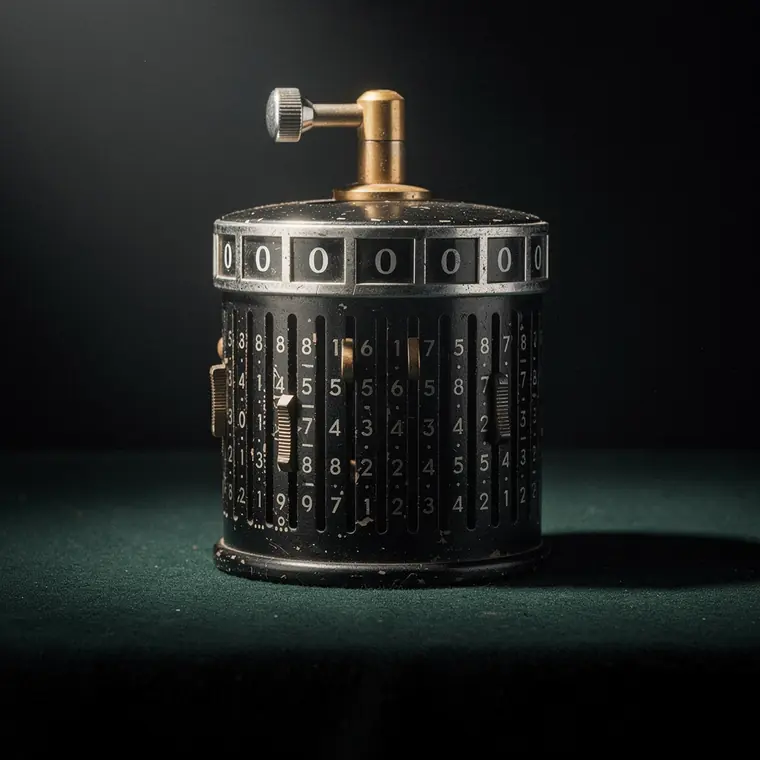
A small cylindrical calculator that fits in a closed hand, a ring of setting sliders around its black body with a small index scale of the digits 0 to 9 beside each slider, a knurled crank on top, a split reading ring of white numerals encircling the crown, each window of the ring showing the single digit 0, every other surface plain black finish and bright steel, standing on a dark baize-covered table before a deep neutral background, a single raking light from the left raking down the ring of sliders.
- What it was used for
- A four-function machine for the hand: eight input positions, six on the revolution counter, eleven in the result register, built from almost 600 individual parts. According to Cliff Stoll it was used by engineers, surveyors and travelling accountants; he tells of an auditor who, without a briefcase-size calculator, tallied the books of a New York bank down to the penny. Sports car enthusiasts adopted it for rallies, because, unlike early electronic calculators, it was unfazed by bumps, vibrations or voltage spikes. A Scientific American advertisement of the 1960s gives the price as 125 dollars.
- What was new
- That all four operations fitted into a pocket was made possible by the single stepped drum with its complement teeth; before, a desk machine was the minimum. The Liechtenstein National Museum records that the Curta had no real competition throughout the lifetime of the product — the Alpina works appeared only in 1959 with a prototype. The year 1948 is not a selling year: according to Hansjörg Nipp about a hundred machines were built that year and, owing to major technical difficulties, none was sold; it bore the name Curta only from April 1949, having been Liliput and Contina before. The barb, according to Cliff Stoll, followed the sales launch, which he places in 1948: six months in, an American department store wanted 10,000 units, and the finance director judged it beyond the company's capability and refused, which left the machine to mail order.
Connections
Every connection names its kind. “Forerunner” on its own would be a claim.
- Follows fromHerzstark's Drawing Table1943Herzstark was sent to Buchenwald in 1943 and there, with the Gustloff works' permission, drew the Curta on Sundays and in the evenings; by his own account the pencil drawing was finished when the war ended. From it Rheinmetall, near Weimar, built three prototypes within eight weeks. The Curta went into series production at Contina in Liechtenstein and was sold from 1949 at the latest.Source: Oral history interview with Curt Herzstark, interviewed by Erwin Tomash, 10-11 September 1987, Nendeln (Liechtenstein). OH 140, Charles Babbage Institute, University of Minnesota - Transkript mit Abstract (86 S., deutsch/englisch) · Curta Type I Calculating Machine - National Museum of American History, Smithsonian Institution (Objekt nmah_690690)
Further reading
- Curta - made in Liechtenstein, Ausstellungstafeln, Liechtensteinisches Landesmuseum Vaduz 2021 (Text Hansjörg Nipp)
- Hansjörg Nipp, The development of Curta I production quantities in the first few years, 2021
- Cliff Stoll, The Curious History of the First Pocket Calculator, Scientific American, Januar 2004, S. 92-99
- Curta Registry, Curta Models