Curta Type II
1954 · Stepped Drum · Work 439 of 1,871
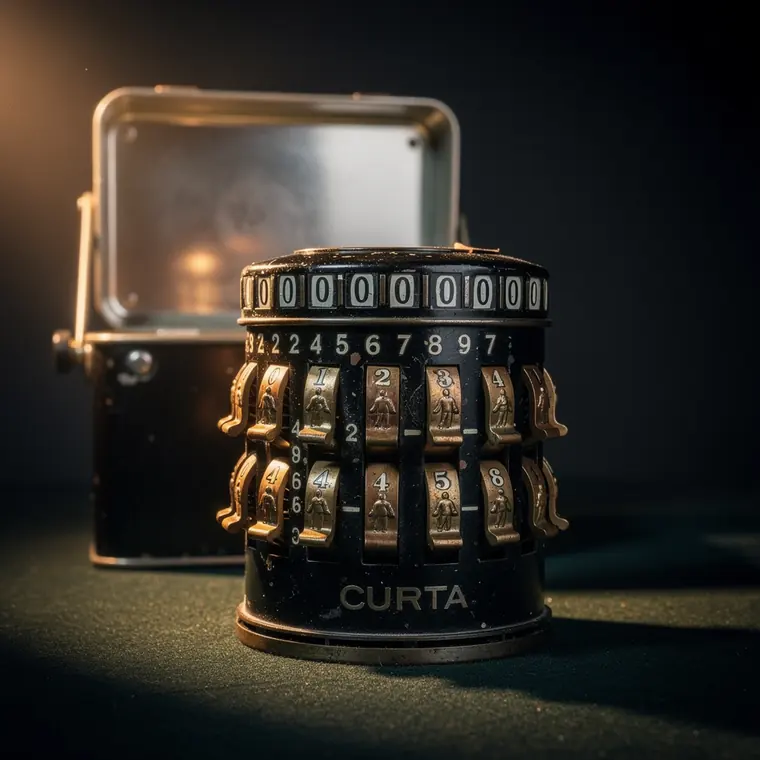
A slightly larger cylindrical calculator with eleven setting sliders in a ring around its body, a small index scale of the digits 0 to 9 beside each slider, a wider reading ring of white numerals around the crown, each window of the ring showing the single digit 0, its black finish worn bright along the edges from years of use, a metal storage tin standing open behind it, every other surface plain black finish and bright steel, the side of the cylinder marked exactly "Curta", standing on a dark baize-covered table before a deep neutral background, a single raking light from the left raking across the worn edges.
- What it was used for
- The larger version of the same machine: eleven input positions, eight on the revolution counter, fifteen in the result register, about 360 grams. It ran alongside the Type I to the end. Between 1948 and 1971, according to the Liechtenstein National Museum, some 79,000 Curta I and 62,000 Curta II were produced, 141,000 in all, of which 95,000 between 1950 and 1965 under Contina AG and 46,000 between 1966 and 1971 under Hilti AG. Cliff Stoll gives 150,000 instead; the figures contradict each other.
- What was new
- Here the honest answer is: little. Stoll describes the Type II as a mere increase in capacity from eleven to fifteen digits, after which the only thing that changed significantly was the shape of the carrying case. The year is not an introduction either: according to Hansjörg Nipp the Type II came to market in 1953, with 2,200 built that year; the Computer History Museum dates its example to 1954, and a Science Museum Group record dates a Type II to 1950, which predates the market launch. The barb is not electronics alone: the market potential had initially been estimated at around three million units, and the museum names as reasons why it never broke through as a mass product organisational and financing problems from the outset, marketing errors and diversification into questionable products. Production ceased at the beginning of 1971.
Connections
Every connection names its kind. “Forerunner” on its own would be a claim.
- Follows fromCurta Type I1948By the Smithsonian's object records the Type I has eight setting slides, an eleven-digit result register and a six-digit multiplier register; the Type II has eleven, fifteen and eight. Both are marked "System Curt Herzstark" and were made by Contina of Mauren; the museum says the Type II was reportedly introduced in 1954, after Herzstark had left the firm.Source: Curta Type I Calculating Machine - National Museum of American History, Smithsonian Institution (Objekt nmah_690690) · Curta Type II Calculating Machine - National Museum of American History, Smithsonian Institution (Objekt nmah_690691)
Further reading
- Curta - made in Liechtenstein, Ausstellungstafeln, Liechtensteinisches Landesmuseum Vaduz 2021 (Text Hansjörg Nipp)
- Hansjörg Nipp, The development of Curta I production quantities in the first few years, 2021
- Cliff Stoll, The Curious History of the First Pocket Calculator, Scientific American, Januar 2004, S. 92-99
- Computer History Museum, Curta mechanical calculator, Type II, S/N 513508 (Kat. 102716155)
- Curta Registry, Curta Models
- Science Museum Group, Curta model II Mechanical Calculator and screw fastened lidded case (co410029)