Zygalski Sheets
1938 · Perforated Sheets · Work 443 of 1,871
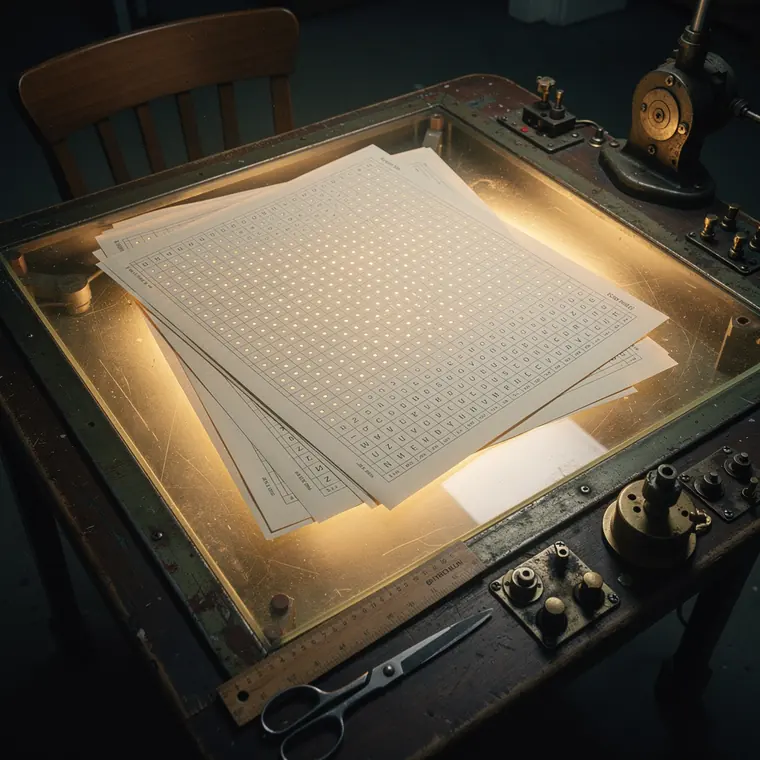
A stack of large stiff paper sheets each ruled into a fine grid of squares, twenty-six squares along each side, a repeated alphabet grid, hundreds of small square holes punched through the sheets in a scattered pattern, several sheets laid one over another on a glass topped light table so that only a few holes line up and let the light through as bright pinpoints, the edges of the sheets slightly offset, a wooden ruler and a pair of scissors at the corner, a lamp beneath the glass glowing up through the paper as the main light, the rest of the workroom dark around the table, a plain wooden chair pushed back.
- What it was used for
- Sets of perforated sheets with which the Polish Cipher Bureau determined the wheel order and ground setting after the card catalogue had become worthless. Each wheel order needed a set of 26 sheets; every sheet carried a grid of 51 by 51 squares from which, according to a contribution in the Science Museum Group Journal, between 900 and 1,000 square holes had to be cut. The operator laid the sheets belonging to the observed "females" on top of one another, offset, on a light box; if a single point of light remained, the setting had been found.
- What was new
- The method moved the computing into the material: the information sat in holes, and light performed the logical conjunction over many conditions. What was new was not punching as such, but that it ran a key search with no mechanism - and that it left the plugboard untouched. The barb is the scissors. For the 60 wheel orders possible from December 1938 a contribution in the Science Museum Group Journal states that 1,560 sheets were needed, each with up to 1,000 holes; the Poles did not finish them before the war. And once the sheets existed, the Germans - according to the Enigma Cipher Centre in Poznań - abandoned the double encipherment of the message key in May 1940, the very practice the method rested on.
Connections
Every connection names its kind. “Forerunner” on its own would be a claim.
- Follows fromEnigma I with Plugboard1932Zygalski laid out the perforated sheets in 1938 directly on the Enigma's rotor arrangement: each sheet stands for one position of the left-hand rotor, the two axes of the 51 by 51 grid for the middle and the right-hand one. Stacked over a light-box, a hole right through marks a possible rotor setting.Source: Elizabeth Bruton u. a.: Zygalski sheets - Polish codebreaking and the role of reconstruction in the Top Secret exhibition at the Science Museum. Science Museum Group Journal
Further reading
- Zygalski sheets: Polish codebreaking and the role of reconstruction in the Top Secret exhibition at the Science Museum (Science Museum Group Journal)
- The Polish Attack on Enigma II: Zygalski sheets (American Mathematical Society, Feature Column)
- Machine against machine (Enigma Cipher Centre / Centrum Szyfrów Enigma, Poznań)