Enigma M4
1942 · Four-Rotor Naval Enigma · Work 450 of 1,871
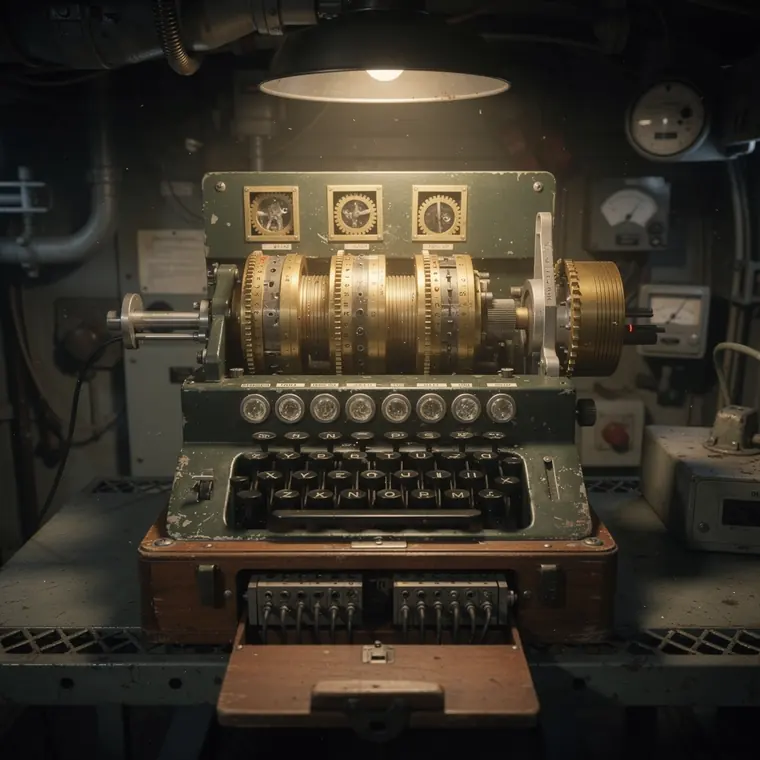
A naval cipher machine in its wooden case with the lid removed, the rotor cover at the top with four small square windows in a row, behind them four cipher rotors standing upright side by side on one spindle, the leftmost rotor visibly thinner than the other three and paired with a narrow reflector beside it, only the serrated brass thumb rims of the rotors showing through slots in the cover, below the cover a lampboard of twenty-six small round glass lamp windows in three rows, below the lampboard a keyboard of three rows of round black keys, below the keyboard in the front face of the case a plugboard of pairs of sockets with short black cables plugged in, a small hinged wooden flap folded down in front of it, the machine standing on a steel shelf in a submarine radio room, a single shaded lamp above at an angle, brass rims and black bakelite catching the light, pipes and grey steel fading into darkness behind.
- What it was used for
- The four-rotor naval Enigma, which entered service on 1 February 1942 on the Triton key net - the circuit of the Atlantic and Mediterranean U-boats, called Shark at Bletchley Park. Beside the three stepping rotors came a fourth, non-stepping "Greek" wheel, Beta or Gamma, together with a thin reflector so that everything still fitted the case of the three-rotor M3. Bletchley Park lost its grip on U-boat traffic. For how long the sources differ: Erskine writes that BP was "blind against Shark for over 10 months", while the Bletchley Park Trust states it "took 9 months".
- What was new
- The fourth rotor was new. What proved decisive, however, was a design decision with no cryptographic purpose: the M4 had to keep talking to the three-rotor machines. Erskine puts it thus: "at one setting of beta, M4 was completely compatible with M3, which was M4's undoing." In exactly that state the short weather signals went out. When a party from HMS Petard seized the second edition of the Wetterkurzschlüssel from U-559 on 30 October 1942 - Anthony Fasson and Colin Grazier died doing it, the sixteen-year-old Tommy Brown survived - Hut 8 had cribs again; a bombe run over 60 rotor combinations in M3 mode took, in Erskine's figures, about 17 hours instead of 442. On 13 December 1942 BP sent the OIC the positions of over twelve Atlantic U-boats.
Connections
Every connection names its kind. “Forerunner” on its own would be a claim.
- Follows fromEnigma M31940The M4 succeeded the M3 and, according to the Crypto Museum, was built on the M3's chassis. Erskine says it was not a true four-rotor machine: the fourth rotor, beta, was the right-hand half of a split reflector and not interchangeable with rotors I to VIII. At one setting of beta the M4 was completely compatible with the M3, "which was M4's undoing".Source: Ralph Erskine: Breaking Naval Enigma (Dolphin and Shark) · Enigma M4 (Crypto Museum) · The Breaking of German Naval Enigma (Tony Sale, Codes and Ciphers Heritage Trust)