Enigma M3
1940 · Kriegsmarine M3 · Work 449 of 1,871
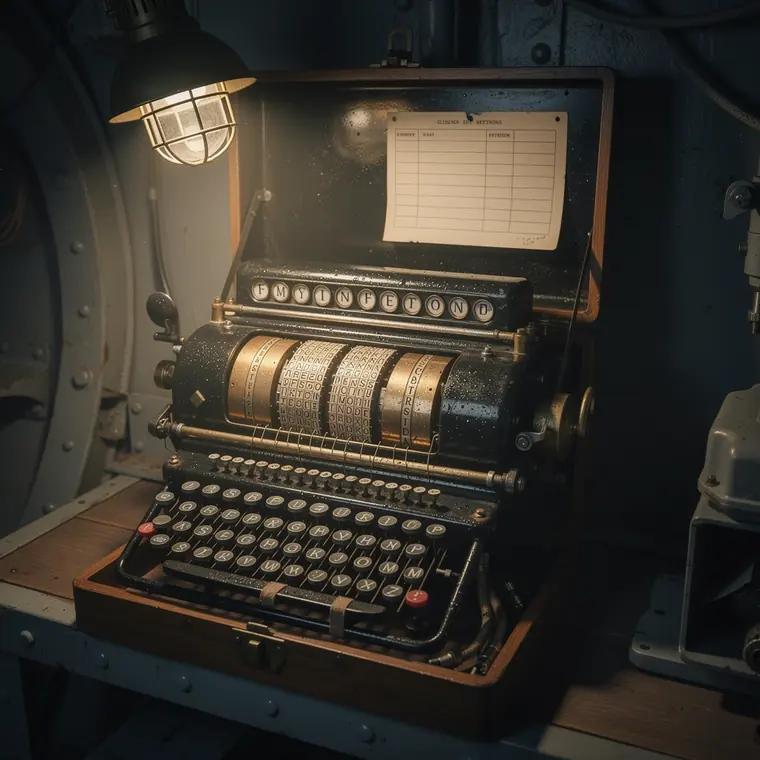
A naval cipher machine in its wooden case with the removable top lid lifted off, a row of three cipher rotors side by side under a lockable rotor cover, the rotor rims engraved with a ring of capital letters, a lampboard of small round windows each bearing a single capital letter, a keyboard below with each key cap bearing a single capital letter, a plugboard of sockets in alphabetical rows at the front, a printed slip clipped inside the lid showing only blank ruled columns, beads of condensation on the metal rotor cover and hinges, the machine on a steel shelf in a cramped ship compartment, a single caged bulb above at an angle, rivets and grey painted steel behind fading into darkness.
- What it was used for
- The naval version of the Enigma, the Funkschlüssel M, built like the army machine but with a stock of eight rotors and its own, stricter key procedure. It covered the radio traffic of U-boats and surface ships. In 1940 Bletchley Park got past it for the first time, with captured material and the aid of the first bombe: Ralph Erskine writes that "in June and July 1940, using some cleartext and cipher text captured from the patrol boat, VP 26, Hut 8 had solved the naval Enigma traffic for six days in April".
- What was new
- What was new compared with the army Enigma was not the machine but the discipline around it: three additional rotors held only by the navy, rotors with two notches instead of one, and a message-key procedure without the double transmission. Precisely the footholds the Polish methods had lived on were thereby removed. The barb: the three naval rotors meant to secure the lead were lost as spoils. Erskine records that "the British recovered rotors VI and VII from the crew of U-33 on 12 February 1940, while rotor VIII was captured in August 1940".
Connections
Every connection names its kind. “Forerunner” on its own would be a claim.
- Follows fromEnigma I with Plugboard1932According to the Crypto Museum, the Navy followed the Wehrmacht's Enigma I in 1934 with the M1, succeeded by the M2 in 1938 and the M3 in 1940, which was based on the Enigma I chassis and functionally identical to it. Erskine writes that the M3 was identical to the Army and Air Force model but was supplied with three additional rotors, VI, VII and VIII, reserved for naval use.Source: Ralph Erskine: Breaking Naval Enigma (Dolphin and Shark) · Enigma M3 (Crypto Museum) · Enigma M4 (Crypto Museum)
- Works withThe Rotor Set1938The M3 takes three wheels out of the set. Erskine: it was identical to the Army and Air Force machine but was supplied with three additional rotors, VI, VII and VIII, reserved for naval use. These each carried two notches, diametrically opposite at H and U, and so stepped the next wheel more often. VI and VII were recovered from the crew of U-33 on 12 February 1940.Source: Ralph Erskine, Breaking Naval Enigma (Dolphin and Shark) · Enigma Variations: An Extended Family of Machines