The Convoy Decision
1941 · Traffic Analysis · Work 453 of 1,871
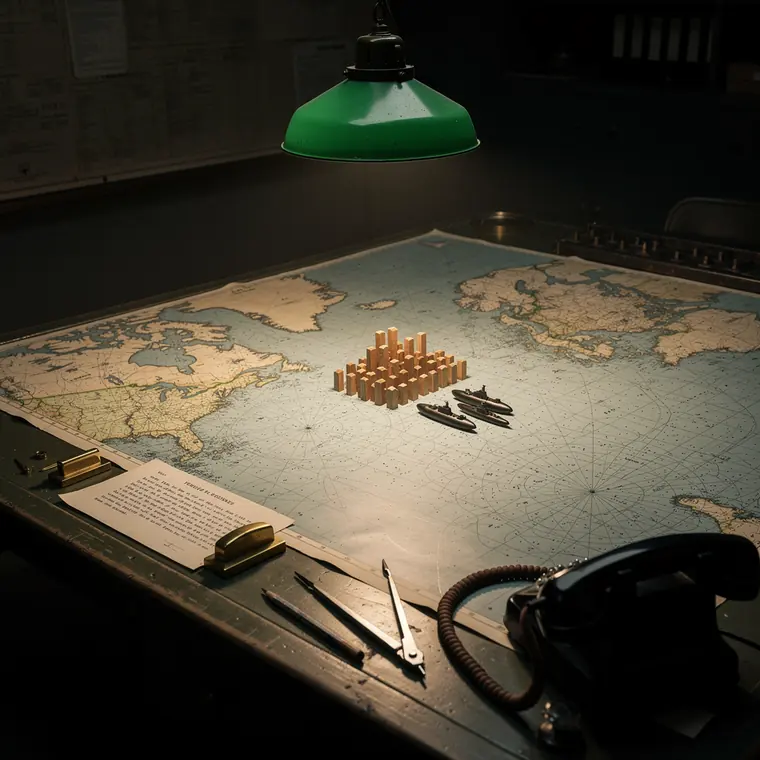
A large plotting table carrying a chart of the North Atlantic, the coastlines of Newfoundland, Iceland and Ireland drawn in fine lines, small wooden convoy markers standing in a cluster on the ocean, a second set of markers shaped as small submarines placed close to them, a typed slip weighted down at the chart edge by a brass paperweight, a black bakelite telephone with its handset lying off the cradle, a straight brown cloth covered cord running from the handset to the telephone body, a pencil and a pair of dividers, a green shaded lamp hanging low over the table as the only light, the operations room around it in darkness, the edge of a wall board fading into shadow.
- What it was used for
- The recurring decision inside the Admiralty's Operational Intelligence Centre to route a convoy around a known U-boat patrol line on the strength of deciphered German signals. The decrypts reached the OIC from Bletchley Park; the order went through Western Approaches Command to the Senior Officer Escort. On 23 June 1941 Western Approaches thus had convoy HX 133 change course; at the same time its escort was reinforced with ships from two westbound convoys to 13 warships, and RAF Coastal Command aircraft were concentrated ahead of and on either side of the convoy.
- What was new
- What was new was not the rerouting but its basis: for the first time in the Battle of the Atlantic the enemy's own reports were in hand, not just bearings and guesswork, and a single case became a standing procedure. The barb is twofold. Despite the change of course and 13 escorts, HX 133 lost five merchant ships; two U-boats were sunk. And the sum that Ultra saved one and a half to two million tons in the second half of 1941 is contested: Ralph Erskine calls such an assessment "over-simplistic", and Tim D. Lyon lists several simultaneous causes for the fall in losses from July 1941 - fewer U-boats in the Atlantic, the US Navy's involvement, better radar, HF/DF - and concludes it is not possible to say "definitively" which mattered most, though fewer U-boats and the US Navy's involvement were "likely" the most important.
Connections
Every connection names its kind. “Forerunner” on its own would be a claim.
- Follows fromHut 81940The decision rested on Hut 8. Only in June and July 1941 did Hut 8 read the Dolphin naval key without delay, using key papers seized in planned operations from the weather ships München and Lauenburg. Erskine: the resulting intelligence "at last enabled the OIC to re-route many convoys to evade the few U-boats (about 20) then in the North Atlantic".Source: Ralph Erskine, Breaking Naval Enigma (Dolphin and Shark)