Hut 8
1940 · Naval Enigma · Work 469 of 1,871
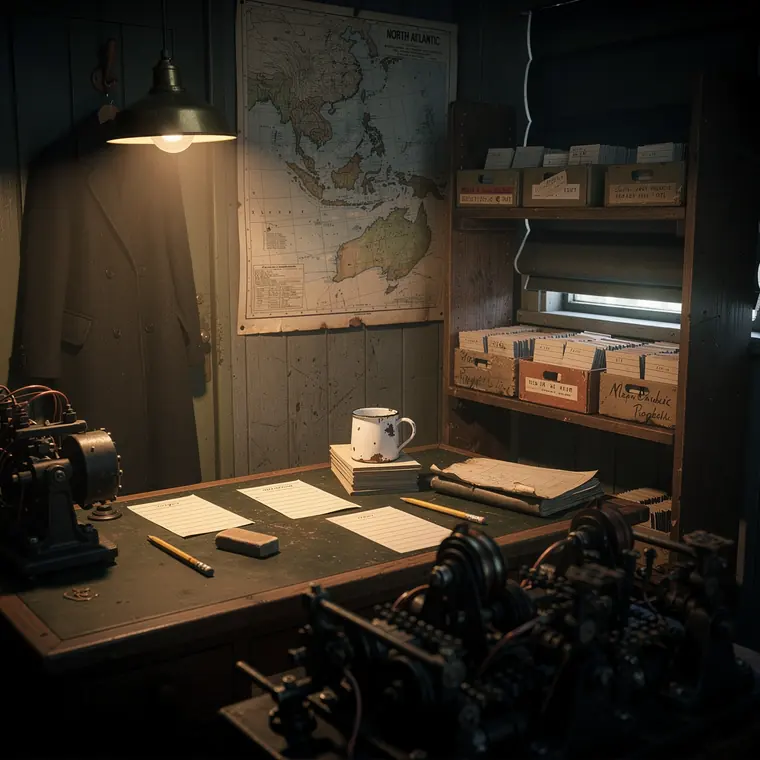
A cramped wooden office with charts of the North Atlantic pinned across one wall, coastlines and grid lines drawn on them, shoe boxes full of index cards stacked along a shelf, a single desk lamp burning on a cluttered desk as the only light, an enamel mug left on a pile of blank intercept slips, a pencil and a rubber, blackout blinds over the window, a coat on a hook by the door, the corners of the office in darkness.
- What it was used for
- Hut 8 worked on naval Enigma. Tony Sale writes that naval traffic was broken here, the U-boat messages in particular, and that Alan Turing's office lay behind the third window from the end of the hut. The break came on 1 February 1942: the U-boats moved to the four-rotor M4, and according to uboat.net Bletchley was blind against the Shark key for over ten months. The way back in came from a capture. On 30 October 1942 Lieutenant Anthony Fasson, Able Seaman Colin Grazier and the sixteen-year-old Tommy Brown boarded the sinking U 559 from the destroyer HMS Petard and took out the second edition of the Wetterkurzschlüssel and the Kurzsignalheft; Fasson and Grazier were posthumously awarded the George Cross. On 13 December 1942 Bletchley was again passing U-boat positions to the Operational Intelligence Centre.
- What was new
- Among Hut 8's methods was Banburismus. GCHQ describes it as a pen and paper method that reduced the computational work of Enigma attacks and names Hugh Alexander as the best at it; who devised it this page does not say. How Alexander came to lead the hut GCHQ gives explicitly as a story: asked to name the head of his section, Turing wrote "Mr Alexander", and so it stayed. What getting back into Shark was worth uboat.net puts cautiously: perhaps 500,000 to 750,000 tons of shipping saved in December 1942 and January 1943 alone.
Connections
Every connection names its kind. “Forerunner” on its own would be a claim.
- Works withThe Turing–Welchman Bombe1940The first bombe, Victory, was operational from 14 March 1940 and at first worked solely for the naval section in Hut 8. Hut 8 tested the bombe results and sent the decrypts on to the Naval Section in Hut 4. In 1942 the Bombe Section was given a room fitted with telephone lines to Hut 8 and Hut 6.Source: The National Museum of Computing: The Bombe - Historical Background · Historic England, List Entry 1391796: Hut 8 at Bletchley Park · Turing Welchman Bombe Rebuild Project: Enter Turing and Welchman
- EncounteredHut 61940The same letter of 21 October 1941: for breaking naval Enigma (Hut 8), Freeborn's Hollerith section immediately needed about twenty more untrained women clerks; for Army and Air Force Enigma (Hut 6), about twenty trained typists were lacking. The two huts acted together in the matter.Source: Letter to Winston Churchill (1941), Kapitel mit Faksimile und Begleittext