Hut 6
1940 · Army and Air Force Enigma · Work 468 of 1,871
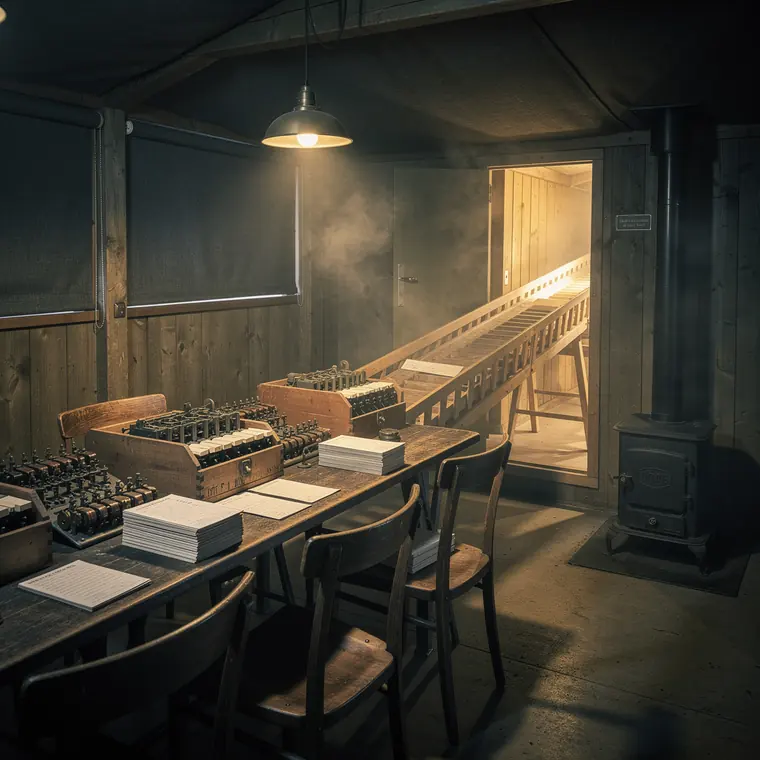
A single storey wooden hut with a felt roof, inside trestle tables heaped with blank message slips, a wooden tray system running through a hatch in the wall, a coke stove in the corner with its pipe rising to the ceiling, blackout blinds over the windows, a single bare bulb in a tin shade hanging over the tables as the main light, wooden chairs pushed back, index card boxes on a shelf, the far end of the hut fading into darkness.
- What it was used for
- In Hut 6 the Enigma traffic of the German army and air force was broken. GCHQ writes of Hugh Alexander that he began in Hut 6 working on Army and Luftwaffe Enigma messages before moving to Hut 8 in 1941. Its head was Gordon Welchman, who came to Bletchley Park in September 1939 and, according to GCHQ, was appointed Head of Hut 6. He rose further: Head of the Machine Coordination and Development Section in September 1943, and Assistant Director of Machines and Mechanical Devices in March 1944.
- What was new
- Welchman's contribution is the diagonal board. GCHQ calls it a dramatic improvement to Turing's Bombe without putting a figure on it; Frank Carter describes the idea more precisely: Welchman realised that the symmetry of each pair of stecker letters allowed a new kind of inference. Carter too gives no figure for the effect, but names two consequences — much less complex menus could be used, and the number of false stops fell considerably. The coda is from GCHQ itself: Welchman's brilliant career was overshadowed by controversy when, in the early 1980s, he published details of his wartime work against the wishes of the UK and US authorities.
Connections
Every connection names its kind. “Forerunner” on its own would be a claim.
- Works withThe Turing–Welchman Bombe1940Ruth Bourne, a Bombe operator at Eastcote, describes how the two worked together: the checker reported a good stop to Bletchley Park over the red voice scrambler; that Hut 6, which handled Army and Air Force Enigma, was at the other end she did not know at the time. When Hut 6 had done its work, word came back through the petty officer of the watch: "Job up!"Source: Bletchley Park Trust, Oral History: Ruth Bourne (WRNS Bombe operator, Eastcote) · B. Naskręcki (Adam-Mickiewicz-Universität Posen), Kapitel 12: Bletchley Park and the Bombe
- Works withZygalski Sheets1938Hut 6 broke Army and Air Force Enigma first by Zygalski's perforated-sheet method, then through the 'cillies', and after August 1940 with cribs and the bombes. The listing entry names a Sheet Stacking Room in Hut 6, superseded in September 1940 by cillies and bombes.Source: Bletchley Park Trust: Gordon Welchman 1906-1985 (Roll of Honour biography) · Historic England, List Entry 1391795: Hut 6 at Bletchley Park
- Works withTypex Mark II1937The Hut 6 section was divided into several departments: the Crib Room prepared cribs for the bombes; the Decoding Room was equipped with modified Typex cipher machines on which Army and Air Force Enigma traffic was decoded.Source: Historic England, List Entry 1391795: Hut 6 at Bletchley Park
- EncounteredHut 81940On 21 October 1941 Turing, Welchman, Alexander and Milner-Barry wrote jointly to Churchill from Bletchley Park under the heading "Hut 6 and Hut 8": staff in both huts were having to do the testing of the bombe results themselves. Churchill ordered that they be given all they wanted on extreme priority.Source: Letter to Winston Churchill (1941), Kapitel mit Faksimile und Begleittext