Typex Mark II
1937 · Typex · Work 456 of 1,871
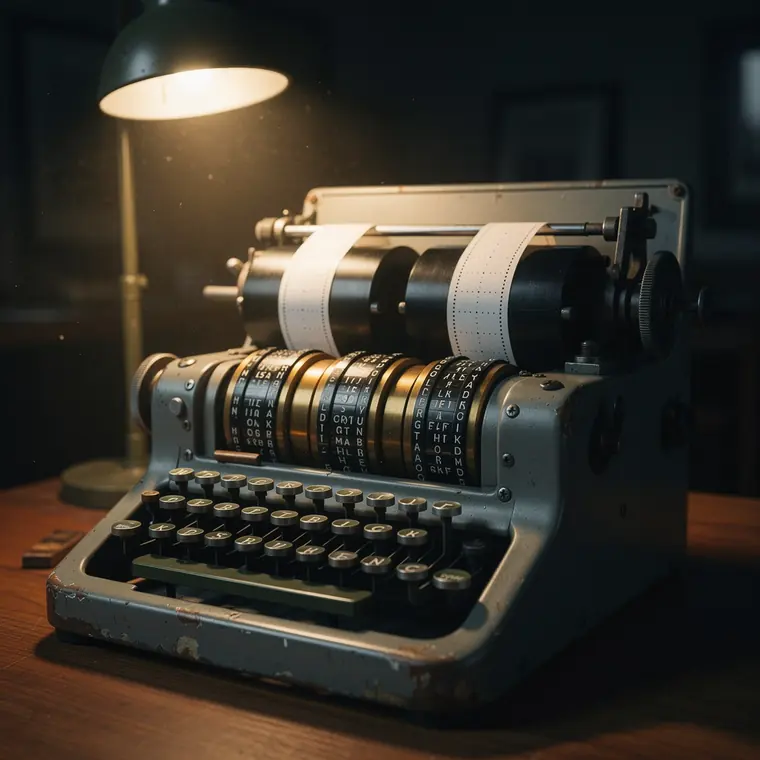
A British cipher machine with a row of five cipher rotors side by side behind the keyboard, the rotor rims engraved with a ring of capital letters, two large black cylindrical printing units mounted side by side above, a narrow paper tape emerging from each, both tapes blank, a keyboard of three rows set low at the front with each key cap bearing a single capital letter, the whole in a painted steel case, standing on a plain wooden table, a single work lamp from above at an angle, black enamel and brass rotor rims catching the light, the signals office behind in darkness.
- What it was used for
- A British cipher machine for the air force and army, developed by Creed & Company from a prototype built at the RAF Wireless Establishment, Kidbrooke. Group Captain O. G. Lywood had borrowed an Enigma to study in 1934; according to jproc.ca he worked with Flight Lieutenant Coulson, the workshop foreman E. W. Smith and Sergeant Albert Lemon. The machine printed cipher and plain text simultaneously on paper tape and had two stationary entrance rotors. On 14 June 1937 the Cipher Committee approved 350 Mk II machines at £107.8.0 each. By September 1941, 3,232 Mk II machines had been produced.
- What was new
- What was new was not the rotor principle - Lywood built avowedly on the commercial Enigma - but the combination of two things it lacked: tape printing, which made the second operator unnecessary, and two stationary entrance rotors. The barb lies in the reputation of unbreakability. The British investigation of 1943 reached no conclusion and was shelved until after the war; the study concludes from the post-war evidence that "Typex messages probably had been read, although on the basis of battlefield captures rather than as a result of Bletchley-style general cryptanalysis". Prisoners testified that after the Tobruk capture they "had been able to set the machine and decode messages" (TNA HW 40/88).
Connections
Every connection names its kind. “Forerunner” on its own would be a claim.
- Works withSIGABA1940In June 1942 it was agreed that the US Navy would design adaptors turning SIGABA and Typex into one common machine: Typex with a CCM adaptor (CCM Mark III), SIGABA with a CCM rotor basket (CCM Mark II). The adaptor went on the Typex Mark 23, a converted Mark II. Limited Royal Navy–US Navy traffic began in November 1943; all five services followed in April 1944.Source: Crypto Cellar Research: Combined Cipher Machine (CCM) · Typex (Crypto Museum) · SIGABA (Crypto Museum)