SIGABA
1940 · ECM Mark II · Work 457 of 1,871
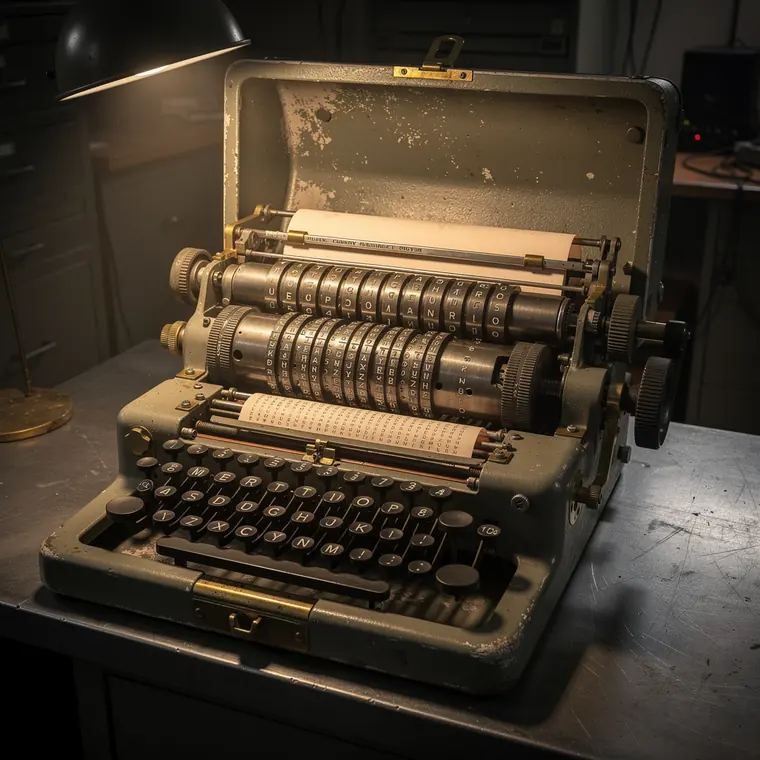
A large American cipher machine with fifteen cipher rotors arranged in three banks of five, three rows of rotors one behind the other, the rear bank of large cipher rotors, the middle bank of control rotors, the front bank of smaller index wheels, the rotor rims engraved with a ring of capital letters, a heavy metal hood hinged open above them, a full keyboard at the front with each key cap bearing a single capital letter, a printing unit above the keyboard with a narrow paper tape, the machine the size of a small suitcase and almost cubical, standing on a steel table, a single work lamp from above at an angle, grey metal and brass catching the light, the cipher room behind in darkness.
- What it was used for
- The machine for the highest-grade traffic of the US armed forces: Army and Navy enciphered with it, for example, the Allied war plans for the 1945 spring assault into Germany. It travelled down to divisions, locked in safes — Timothy Mucklow, for the NSA Center for Cryptologic History, gives a weight of 100 pounds and a speed of 60 words per minute. When production ceased after the war some 10,060 machines were in the inventory. Traffic with the British required conversions; the Combined Cipher Machine linked SIGABA and Typex through adapters. It was not broken — but it was lost: on the night of 5 February 1945 a truck carrying a SIGABA and its rotors was stolen at Colmar. Eisenhower ordered the investigation; the truck turned up near Rambervillers on 9 March, the lower safe half only on 20 March.
- What was new
- What was new was not the rotor principle — Hebern had built a working model by the end of 1915. What was new was that the machine generated its own irregular stepping: five cipher rotors were driven by five control and five index rotors so that one to four of them advanced per keystroke, in a varying selection, where Hebern's wheels stepped regularly and predictably. Mucklow traces the idea to Frank Rowlett around 1934/35, building on Friedman's tape-driven M-134. No wartime break is on record; the Crypto Museum notes that the machine is attackable with present-day computing power.
Connections
Every connection names its kind. “Forerunner” on its own would be a claim.
- Follows fromHebern Electric Code Machine1918The official "History of Converter M-134-C" begins its direct line of development with Hebern's machine, shown to the Chief Signal Officer in 1923, and calls its mechanical, metered rotor stepping its cryptographic weakness. Friedman therefore had the rotors stepped by a key tape; Rowlett replaced the tape with a second set of rotors that generates the irregular stepping.Source: History of Converter M-134-C (declassified, Friedman Collection) · Timothy J. Mucklow: The SIGABA/ECM Cipher Machine - A Beautiful Idea (NSA Center for Cryptologic History)