The Tunny Machine
1942 · British Lorenz Emulator · Work 465 of 1,871
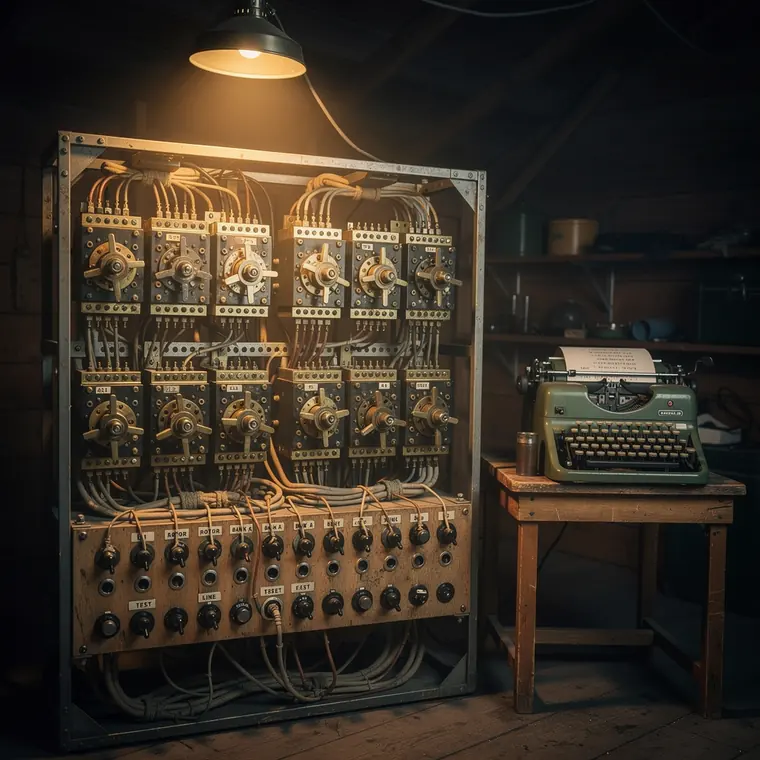
A home built rack of electromechanical relays and uniselector switches assembled to imitate an enemy cipher machine, rows of relays with brass contacts, twelve uniselector switches with sweeping wiper arms, a jury of toggle switches on a plywood front panel, small plain labels of card tied to each unit, cloth covered wiring bundled along the frame, a teleprinter at the side, the rack standing in a hut workroom, a single work lamp from above at an angle, brass contacts and bakelite catching the light, the hut behind in darkness.
- What it was used for
- The British machine at the end of the chain. Once Colossus or hand methods had found the wheel settings, the cipher text was run through the Tunny: it reproduced the Lorenz and printed out the German plain text. The National Museum of Computing calls it a re-engineering of the then unseen Lorenz SZ42, designed by the Post Office Research Station in 1942, and estimates that by the end of the war there were between twelve and fifteen of them, probably in Block F at Bletchley Park. The museum names Bill Tutte, of the Research Section, as leader of the team that worked the machine out from its output.
- What was new
- It was built without anyone at Bletchley ever having seen the original — as the US Purple analog of the Japanese diplomatic machine had been in 1940. There was no captured specimen, no drawing, no manual — only cipher text and the key Tiltman had carried through. The National Museum of Computing records that nobody at Bletchley saw a real Lorenz before the end of the war. That probably twelve to fifteen of these replicas were built and delivered plain text day after day is itself the test of the deduction.
Connections
Every connection names its kind. “Forerunner” on its own would be a claim.
- Follows fromLorenz SZ401940In January 1942 Bill Tutte deduced the structure of the Lorenz machine, whose first model was the SZ40, from 4,000 characters of key recovered by Tiltman from intercepts; the SZ42A came only in February 1943. No one at Bletchley Park had seen it. Early in 1942 the Post Office at Dollis Hill was asked to implement this logic; Frank Morrell built the Tunny machine from it.Source: B. Jack Copeland, Colossus: Breaking the German 'Tunny' Code at Bletchley Park. An Illustrated History, The Rutherford Journal 3 (2010) · Tony Sale (Codes and Ciphers Heritage Trust): Lorenz ciphers and the Colossus · The National Museum of Computing: Tunny and Heath Robinson
- Works withColossus Mark 11943Colossus and the British Tunny replicas worked in one chain at Bletchley Park: Colossus read the ciphertext from punched tape and found the chi-wheel settings by counting. Once all wheel settings were found, the ciphertext was keyed into a replica Tunny machine and the German plaintext emerged. Without the correct starting positions Tunny could not decipher anything.Source: Frank Carter, Colossus and the Breaking of the Lorenz Cipher · B. Jack Copeland, Colossus: Breaking the German 'Tunny' Code at Bletchley Park, The Rutherford Journal
Further reading
- The National Museum of Computing: Tunny and Heath Robinson
- John H. Tiltman: The 'Tunny' Machine and Its Solution (NSA, DOCID 3838610)
- Wes Freeman, Geoff Sullivan, Frode Weierud: PURPLE Revealed — Simulation and Computer-aided Cryptanalysis of Angooki Taipu B
- Jerry Proc: Improved Japanese Purple Analog