Forth Bridge
1890 · Steel Cantilever Bridge · Work 48 of 1,871
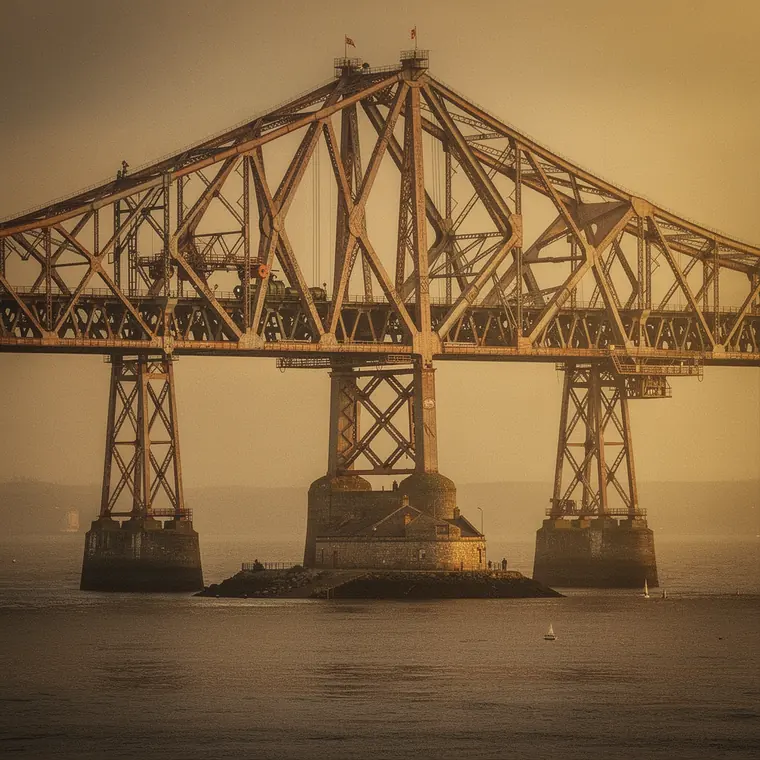
The Forth Bridge with three balanced cantilever towers of tubular steel struts and lattice ties, the central tower planted on Inchgarvie island, suspended spans linking them above the firth.
- What it was used for
- A double track railway bridge over the Firth of Forth at Queensferry, opened on 4 March 1890 and first used on 21 January. It completed the east coast route from Edinburgh to Aberdeen, saving the ferry and the detour via Stirling; it still carries passenger and freight traffic. Total length 2,467 m, two main spans of 1,700 feet (520 m), 110 m above high water, 6.5 million rivets, 4,000 to 4,600 men at peak. The steel is given as 54,000 to 55,000 tons and the cost at about 3.2 million pounds, including 250,000 pounds for the abandoned work on the earlier design.
- What was new
- The cantilever principle was not new - Gerber's bridge at Hassfurt of 1867 had a 124 ft central span, and the Kentucky River Bridge of 1877 showed that the main span needs no falsework. What was new was the jump in scale, from tens to hundreds of metres, and the reason for it: after the Tay collapse the design was deliberately conservative and overbuilt, with wind loading as a governing case. Bouch's 1871 suspension design was dropped after 1879 and the 250,000 pounds already spent on it were lost. The construction death toll is disputed and rests on reconstruction rather than an official count: Westhofen gave 57, by 2009 researchers had connected 73 deaths with the work, and a 2019 report named at least 21 more, some 78 in all.
Connections
Every connection names its kind. “Forerunner” on its own would be a claim.
- Follows fromFirth of Tay Bridge1878The Tay Bridge collapse of 1879 ended Bouch's suspension design for the Forth, whose foundations had been laid in 1878; it was formally rejected in 1881. Fowler and Baker built a cantilever instead, designed against high wind pressure - the very quantity the Tay design had never allowed for.Source: Historic Environment Scotland Blog: The Forth Bridge · The Public Domain Review: The Forth Bridge - Building an Icon