Tower Bridge
1894 · Steel Truss Bascule Bridge · Work 49 of 1,871
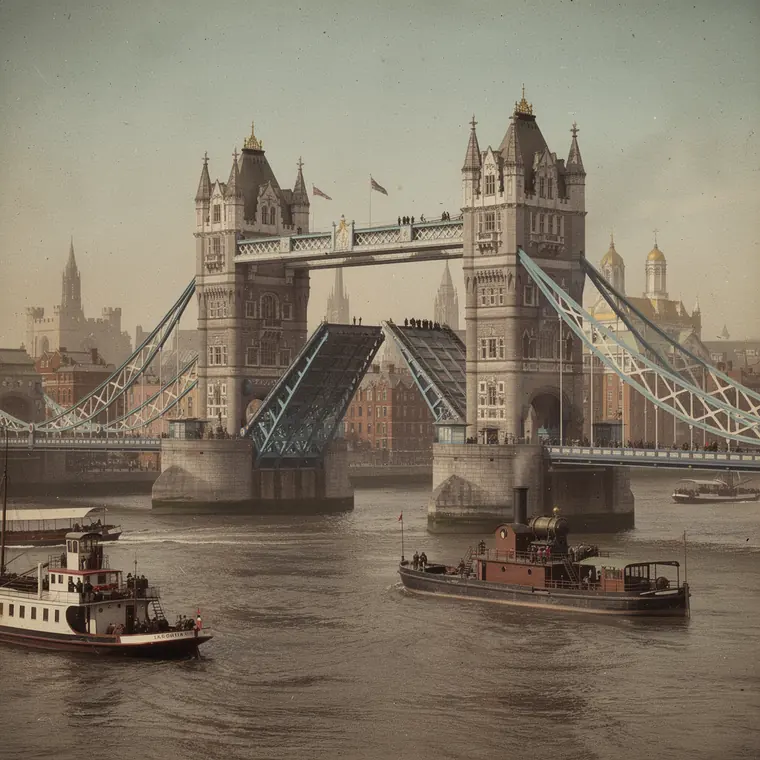
Tower Bridge with both bascules lifted over the Thames, the two leaves hinged at the foot of the towers and raised steeply toward each other, the two Gothic-clad steel towers faced in granite and Portland stone, the two high-level lattice footbridges strung between the towers, suspension side spans running to the river banks, engine house chimney beside the southern approach, the Tower of London low on the north bank, the skyline behind made only of low brick warehouses, roofs and church spires, the river surface carrying only boats and steamers, people only on the bridge, on the banks and aboard vessels.
- What it was used for
- A road and foot bridge over the Thames below London Bridge, opened on 30 June 1894, designed by Horace Jones and John Wolfe Barry. East London needed a crossing, but the Pool of London was a working port: ships had to pass further upstream. Hence the bascules - raised, by the operator's own count, 6,194 times in the first year, seventeen times a day on average; today around 800 times a year. The recorded cost was 1,184,000 pounds; the operator itself puts the true cost nearer 1.6 million. Eight contracts, an average of 432 men on site.
- What was new
- Bascule bridges and hydraulic power were both known; what was new was the scale and the housing: counterweights and machinery sit entirely within the piers, driven by pressurised water from six accumulators filled by steam engines. About 11,000 tonnes of steel form the frame of the towers and walkways. The towers look like masonry but are clad - Cornish granite and Portland stone over steel, to protect the steel and to meet the requirement that the bridge suit the Tower of London. Contemporaries found this dishonest: the architectural critic Henry Heathcote Statham spoke of "the vice of tawdriness and pretentiousness", and A Book of Bridges (1915) - text by Walter Shaw Sparrow, pictures by Frank Brangwyn - calls it the most absurd structure ever thrown across a strategic river. The change to electro-hydraulic drive on oil began in 1974 and was complete in 1976.
Connections
Every connection names its kind. “Forerunner” on its own would be a claim.
- Follows fromForth Bridge1890In May 1889, a year before the Forth Bridge was completed, the contract for Tower Bridge's steel and ironwork went to William Arrol & Co., the firm then building the Forth Bridge. It supplied and erected 11,000 tons of steel. Arrol ran both sites at the same time; James E. Tuit, on the Forth Bridge until 1889, went to London to take charge of Tower Bridge construction for Arrol.Source: Tower Bridge (City Bridge Foundation): Sir William Arrol · ICE Museum Scotland (Heriot-Watt University): Forth Bridge Biographies, William Arrol