Paddington Station
1854 · Wrought Iron Train Shed · Work 50 of 1,871
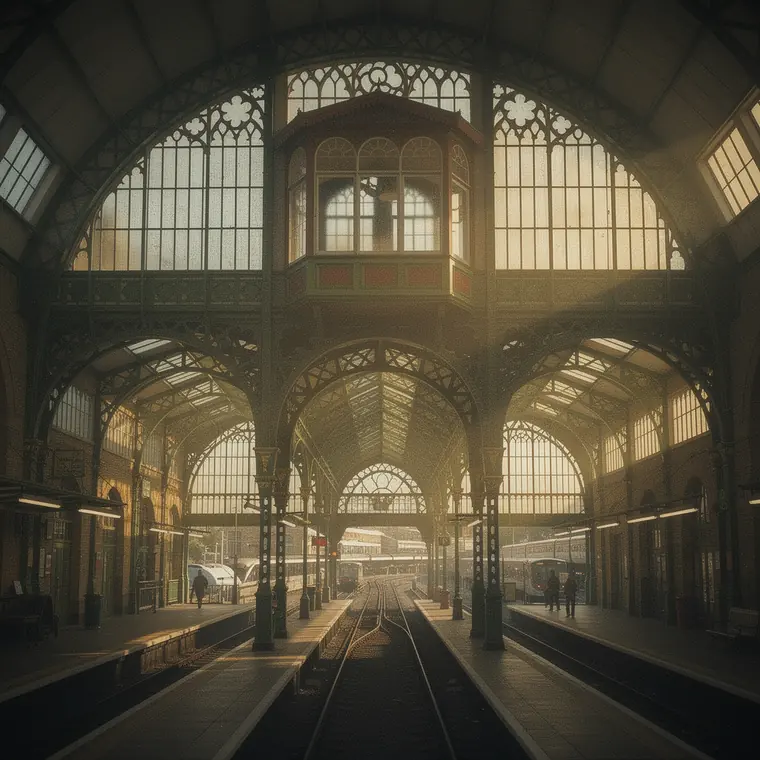
Paddington Station's train shed, three wrought iron arched spans crossed by two glazed transepts, Moorish tracery filling the end screens, oriel window of the company boardroom overlooking the platforms.
- What it was used for
- The Great Western Railway's London terminus, replacing the temporary station on the west side of Bishop's Bridge Road of 1838. The first train left the unfinished shed on 16 January 1854; the station opened formally on 29 May 1854. Traffic ran from here to Bristol, South Wales and Cornwall. Brunel designed the shed and Matthew Digby Wyatt the ornament: three wrought iron arched spans of 68, 102 and 70 feet (21, 31 and 21 m) over a length of 699 feet (210 m); a fourth span of 109 feet (33 m) was added between 1906 and 1915.
- What was new
- What was new was not the construction but its transfer: the shed takes the method and the language of the 1851 exhibition building - wrought iron and glass, repeated prefabricated parts, no load-bearing wall - and applies them to a railway station. The station was built for Brunel's broad gauge of 7 ft 0 1/4 in; the last through broad gauge train left Paddington on 20 May 1892, after which 171 route miles were converted between 20 and 23 May by over 4,000 men. The shed stayed; the gauge it was built for lasted 38 years. The two transepts are usually said to have held traversers, but recent work on early documents and photographs does not support this and their purpose is unknown.
Connections
Every connection names its kind. “Forerunner” on its own would be a claim.
- Follows fromCrystal Palace1851Brunel took the exhibition building's people to the station: the same ironwork contractor, Fox, Henderson & Co., prefabricated wrought iron arches and glass, and Matthew Digby Wyatt and Owen Jones for the ornament. The London Museum traces the three barrel vaults directly to the Crystal Palace.Source: London Museum: Paddington Station - For bears & westward travel · Country Life: Paddington Station - The everyday masterpiece · The Architects' Journal: Station masters