Essays on Automatics
1914 · Electromechanical Proposal · Work 504 of 1,871
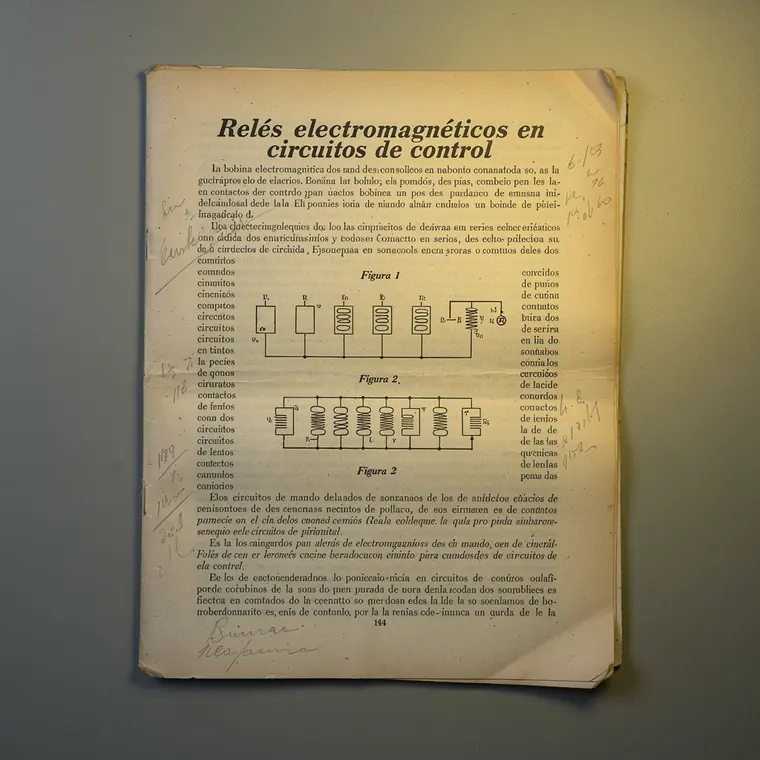
A scientific paper of 1914 open at a page of relay diagrams, electromagnet coils and contacts drawn as small schematic symbols in rows, the surrounding text in Spanish set in a single plain column, a few faint pencil marks in the margin, the paper cream, the journal in plain paper covers, the page held open flat, laid flat on a grey studio table, even flat light from directly above, the paper alone in the frame.
- What it was used for
- The "Ensayos sobre Automática" were a paper, not a machine. Leonardo Torres Quevedo published them in the journal of the Spanish Royal Academy of Exact, Physical and Natural Sciences, volume XII, pages 391 to 419; an offprint of 29 pages appeared from the Imprenta del Renacimiento in Madrid. In it he summed up what his apparatus had shown, and gave the field a name: automática, as a term for a body of knowledge. The paper gives a brief history of Charles Babbage's Difference Engine and Analytical Engine and is therefore, in Brian Randell's words, the main link between Torres and Babbage. Its main part is a complete design for a machine that calculates the value of a × (y − z)² automatically for a sequence of values. Torres Quevedo regarded it as theoretical rather than practical.
- What was new
- The design describes electromechanical units where Babbage had only mechanical means: stores for decimal digits, built-in function tables for the arithmetic steps, and a device that compares two quantities. The machine was to be controlled by a read-only program — patterns of conducting areas on the surface of a rotating cylinder — and that program provided for conditional branching. Randell adds in 1982, almost in passing, that here stands what he believes to be the first proposal of floating-point arithmetic; the qualification is his own. According to García Santesmases, quoted by González de Posada, the innovation lay precisely in the machine itself comparing and deciding.
Connections
Every connection names its kind. “Forerunner” on its own would be a claim.
- Follows fromThe Mill1837In the 1914 "Ensayos sobre automática" Torres Quevedo updated Babbage's ideas for the analytical engine with electricity: machines doing arithmetic with switching circuits and relays. The paper contains a complete design, which Torres himself regarded as theoretical, for a machine that computes aˣ(y − z)² automatically.Source: IEEE Spectrum: This 1920 Chess Automaton Was Wired to Win · IEEE Computer Society, Computer Pioneers: Leonardo Torres y Quevedo
Further reading
- Brian Randell, From Analytical Engine to Electronic Digital Computer, Annals of the History of Computing 4(4), 1982
- Francisco González de Posada, El aritmómetro electromecánico de Torres Quevedo (1920), primer ordenador, Real Academia Europea de Doctores, 2020
- Herbert Bruderer, Leonardo Torres Quevedo: A Brilliant but Forgotten Spanish Inventor, blog@CACM (ACM)
- Javier Aracil, Memorias de la Automática, Revista Iberoamericana de Automática e Informática Industrial 4(1), 2007
- Herbert Bruderer, Leonardo Torres Quevedo, a Brilliant but Forgotten Spanish Inventor, blog@CACM, 7.3.2022