Note G
1843 · Bernoulli Algorithm · Work 508 of 1,871
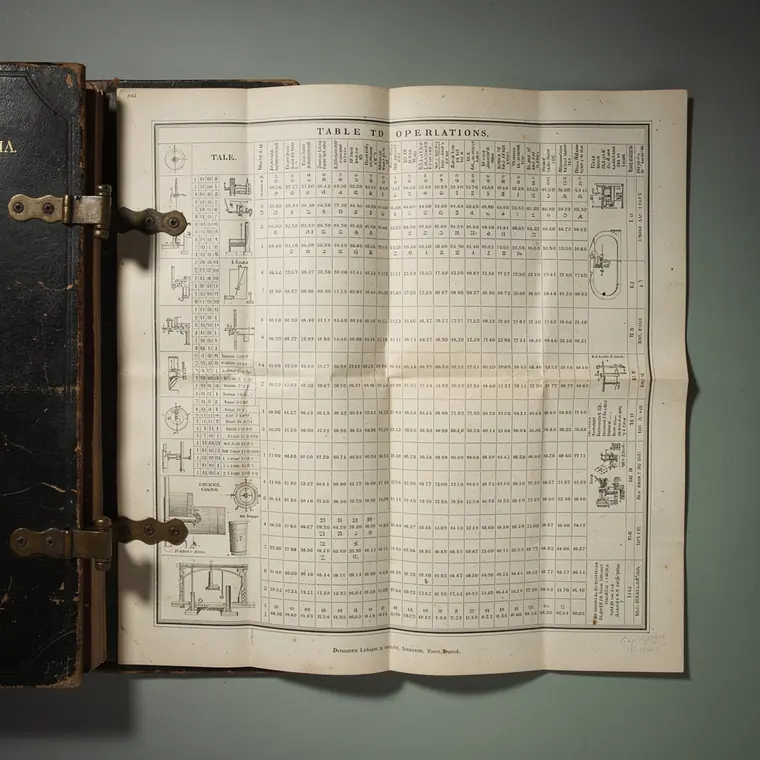
A printed foldout table of operations of 1843, ruled columns and rows, each row one step of a calculation, fine printed type in the cells, the sheet folded out from a bound volume and creased where it folds, the volume itself half visible at the edge, the columns of the table separated by fine ruled lines, the paper cream, the table laid flat on a grey studio table, even flat light from directly above, the sheet alone in the frame.
- What it was used for
- Note G is the last of seven notes Ada Lovelace added to her translation of Luigi Federico Menabrea's paper on Babbage's Analytical Engine. Translation and notes were printed in 1843 in Taylor's Scientific Memoirs, volume III, pages 666 to 731; the notes begin on page 691 and are signed with the initials A. A. L. Note G follows step by step how the engine would compute the numbers of Bernoulli, and includes a folding diagram and table, bound in between pages 730 and 731 in the scanned copy. Lovelace works it out there: nine operation cards for n = 1, fourteen for n = 2, and twenty-five for any n greater than 2 — and never more, however great n may be. Babbage wrote in 1864 that the notes of the Countess of Lovelace extend to about three times the length of the original memoir.
- What was new
- Whether this was the first program is disputed, and by name. Allan G. Bromley wrote in 1982 that there are several dozen sample programs by Babbage prepared between 1837 and 1840, all substantially predating Lovelace's notes, several of which the notes incorporate; the Science Museum Group records 27 sets of such notations on 36 sheets, dated 1836 to 1840. Thomas J. Misa objected in 2022 that Bromley had for years dismissed Lovelace, while himself calling the label "first programmer" unhelpful and anachronistic, since the concept dates from decades later. Bromley calls the Bernoulli program the most complex of its style, requiring a nested-loop structure with a varying range for the inner loop. Babbage wrote in 1864 that he had worked the algebra for it himself — and that Lovelace sent it back to him, having detected a grave mistake he had made in the process.
Connections
Every connection names its kind. “Forerunner” on its own would be a claim.
- Follows fromThe Card Reader1836The procedure is written for the Analytical Engine's card control and cannot be executed without it.
- Follows fromThe Store1837The columns of the Note G table are the Store's variables. The Bodleian account describes exactly that movement: the quantities are fetched from the Store, worked on in the Mill and put back again, according to the instructions on the cards.Source: Ada Lovelace and the Analytical Engine (Bodleian Libraries, University of Oxford)
Further reading
- Scientific Memoirs, Vol. III (1843), Article XXIX, Sketch of the Analytical Engine … with Notes by the Translator, S. 666–731 (Originaldruck, Scan)
- Charles Babbage, Passages from the Life of a Philosopher, London 1864, S. 136
- Allan G. Bromley, Charles Babbage's Analytical Engine, 1838, Annals of the History of Computing 4(3), Juli 1982
- Science Museum Group, Notations of calculations for the Analytical Engine (BAB/L), 1836–1840
- Thomas J. Misa, Comment on: Was Ada Lovelace Actually the First Programmer?, arXiv:2402.00749