Sholes & Glidden Type-Writer
1874 · Understrike · Work 522 of 1,871
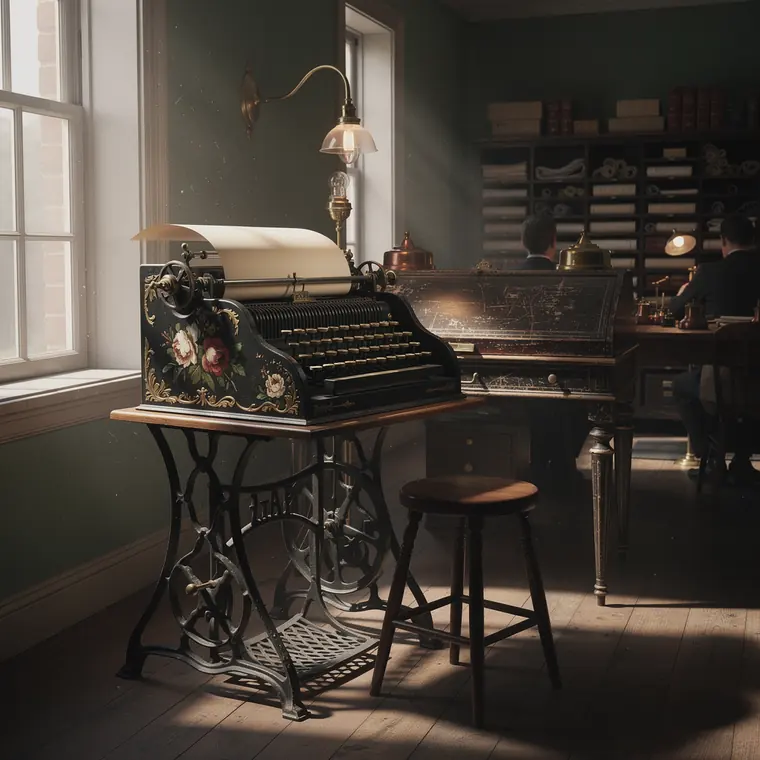
A black typewriter on a cast-iron treadle stand of the sewing-machine kind, painted flowers and gilt scrollwork spread across its curved japanned cover, a foot pedal beneath the stand linked to the carriage by a rod, each key cap bearing a single capital letter, the platen enclosed beneath the cover so the typed line stays hidden inside the machine, a sheet of plain paper rolled in at the top, the stand placed near a tall window on the left so raw daylight rakes across the gilt, a gas lamp on a swan-neck bracket above the desk, a slant-top clerk's desk and high stool beside it, a pigeonhole cabinet against the far wall, the counting room stretching into dimness with brass inkwells catching the last of the light.
- What it was used for
- The Sholes & Glidden was the first typewriter to come out of a factory in quantity. On 1 March 1873 James Densmore signed a contract with E. Remington & Sons at Ilion, New York: the gun and sewing-machine works was to build at least a thousand machines, and Densmore paid 10,000 dollars for the manufacturing. The machine stood on a treadle sewing-machine stand, had forty-four glass-topped keys in four banks and wrote capitals only. The types struck upward against the platen, so the line being written lay under the platen and could not be seen. The sales catalogue listed reporters first among its users, then lawyers, editors, authors and clergymen. Mark Twain wrote at the end of 1874 that the machine cost one hundred and twenty-five dollars.
- What was new
- Not the first typewriter - there had been many, and on the ASME's account the predecessors, in Sholes's judgement, each failed at least one of three requirements: simple and not liable to get out of order, workable rapidly, and reasonably cheap. What was new was that this machine was made in a factory with mass-production plant, and that it brought a key arrangement that still holds. Sholes and Densmore deliberately did not order the letters alphabetically, so that the type bars would not collide at speed - that produced QWERTY. The barb: the machine that rebuilt the office barely sold for years. The 1923 company history gives 1881, when E. Remington & Sons took over selling themselves, as a year of twelve hundred machines sold. And it changed who sat in the office: in 1870, on the Early Office Museum's figures, five per cent of American stenographers and typists were women; in 1900, seventy-seven per cent.
What the sources leave open: The price comes from Mark Twain's letter of 9 December 1874, which the 1923 company history prints in full. The figure of twelve hundred applies to Remington's typewriter business in 1881, not to this model. The percentages are attributed by the Early Office Museum to Kwolek-Folland (1994); the ASME brochure gives a differing figure for 1900, about 75 per cent women among all clerical workers.
Connections
Every connection names its kind. “Forerunner” on its own would be a claim.
- EncounteredStatue of Liberty1886At the 1876 Centennial Exhibition in Philadelphia the Sholes & Glidden machine, sold as the Remington No. 1, had its first public showing. The same exhibition displayed the hand and torch of the Statue of Liberty - the first part of the statue to be seen in the United States.Source: Bureau International des Expositions: A to Z of innovations at Expos - QWERTY keyboard · West Philadelphia Collaborative History (University of Pennsylvania): A History-Making Event in West Philadelphia