Statue of Liberty
1886 · Iron Pylon with Copper Skin · Work 69 of 1,871
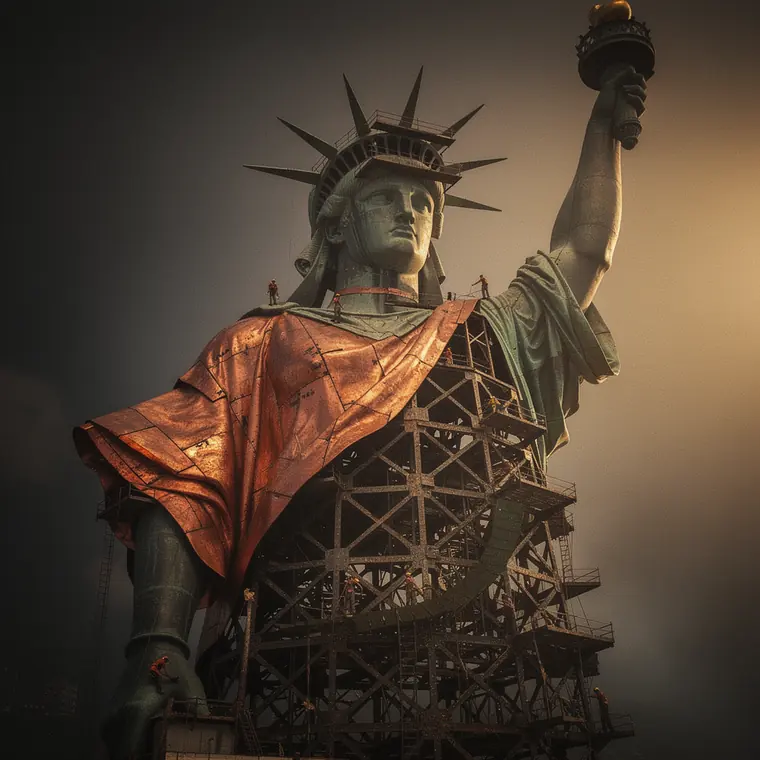
The workshop assembly of a colossal copper statue, a bare iron lattice pylon standing inside a scaffolded hall, sheets of hammered copper skin leaning against the walls and being lifted into place, workmen on staging beside a partly clad shoulder and raised arm.
- What it was used for
- For sixteen years it was an official lighthouse. On 22 November 1886 President Cleveland handed it to the United States Light-House Board, which employed keepers and housed them on the island; fifteen arc lamps burned, nine of them in the torch. As a navigational light it was useless: the officer in charge, Lt. John Millis, reported as early as 1886 that the lamps were seen at full power from a distance and faded to obscurity as one approached the island. In December 1901 Secretary of War Elihu Root wrote to Roosevelt that the light was useless so far as navigation was concerned; in 1902 the lighthouse service gave the statue up. The pedestal had long lacked money: Joseph Pulitzer's appeal raised over 100,000 dollars in six months from roughly 125,000 contributors, most of them giving a dollar or less.
- What was new
- The copper skin does not hang rigidly. Three hundred hand-raised sheets 2.4 millimetres thick, joined by some 300,000 copper rivets, sit on a network of 1,850 iron bars, and they are not soldered but held by about 1,500 copper saddles. Copper and iron can therefore expand independently, and the bars act as springs under wind load - 80 tonnes of copper allowed to work over some 120 tonnes of iron. The original design was different: Eugène Viollet-le-Duc intended the figure to stand on sand-filled masonry compartments, and only after his death in 1879 did Eiffel's office take over.
Connections
Every connection names its kind. “Forerunner” on its own would be a claim.
- Follows fromViaduc de Garabit1884For Garabit, finished in 1884, Maurice Koechlin used trussed piers to resist wind. The National Park Service's Historic Structure Report says the analytical method and design concept "already familiar to Koechlin" were applied to the Statue's iron pylon, begun in 1881 while Garabit was still being built; the wind load of 270 kg per square metre used for viaducts was used for the Statue as well.Source: John G. Waite Associates für den National Park Service: Statue of Liberty, Historic Structure Report (Mai 2011), S. 19–20 · RWTH Aachen, Lehrstuhl für Tragkonstruktion: Maurice Koechlin – der eigentliche Erfinder des Eiffelturms
- EncounteredSholes & Glidden Type-Writer1874Centennial Exposition, Philadelphia 1876: the hand with the torch was displayed there to raise money for the pedestal; the complete statue was not dedicated in New York until 1886. At the same fair the Type-Writer, first sold in 1874 and today called the Model 1 Remington, was on show; about the only revenue the exhibitors took came from typewriting samples at a quarter apiece.Source: U.S. National Archives, Prologue: Body of Iron, Soul of Fire - The Statue of Liberty · Herkimer County Historical Society: The Story of the Typewriter 1873-1923 (1923)
Further reading
- John G. Waite Associates u.a., Historic Structure Report: Statue of Liberty, NPS 2011
- National Park Service: Statue Statistics (Kupferstärke)
- National Park Service: Joseph Pulitzer (100.000 Dollar, 125.000 Spender)
- ASCE Metropolitan Section: Statue of Liberty (Eisengerüst, Windlast, Ausdehnung)
- NPS: Liberty Island, Verwaltung 1886-1902 durch das Lighthouse Board